Liz Magic Laser
in conversation with
Julia Schäfer
The following conversation between Liz Magic Laser and Julia Schäfer occurred via Zoom on Thursday, September 17, 2020, at 11:00 New York/17:00 Amsterdam with an audience of students from the Sandberg Instituut, the Yale School of Art, and the Werkplaats Typografie.
Download this conversation as a PDF
ANGIE KEEFER Liz Magic Laser is a multimedia video and performance artist based in New York City. She was born in the 1980s. Since this audience is students, I will tell you briefly that her educational path was through a liberal arts college, followed by an MFA at Columbia. She also attended the Whitney Independent Study Program and the Skowhegan School of Painting and Sculpture. She works primarily with performance, often in sculptural installations that are video-based. She is especially interested in the performance of power in public space. For example, one recent project, which took place at the Centre Pompidou in Paris, involved dancers who developed a choreography derived from personality testing data that related personality type to political orientation. She’s going to be speaking to you about a work called In Real Life, which was filmed primarily by subject-participants via Zoom and other apps. I’m going to leave it to her to say more about that work in her conversation with Julia Schäfer, who is a Swiss-born designer coming to us from the 1990s. Julia’s work, as it turns out, has a lot of overlap with Liz’s. She is a very recent graduate of the MFA program at Yale, and her typographic research there had to do with, in her words, “disrupting an otherwise seamless integration of bodies and technology.” She has developed numerous typefaces using various machine-enabled techniques for capturing human movements and human-machine interaction. For example, she used bio-data from eyetracking to generate typefaces based on how the eye tracks letterforms on screen. She will be saying more about her work in conversation with Liz, as well.
LIZ MAGIC LASER Thank you for that introduction and for introducing me to Julia and her work. We’ve just been getting to know each other over the last week or two, finding unexpected things in common—similar subjects in our work that we’re approaching from very different angles. I’ll do a screen share and tell you a little bit of the backstory for this experimental reality show I did with online gig workers.
This work came out of a commission from an institution in Liverpool called FACT—Foundation for Art and Creative Technology. They were doing a year-long program about the future of work, and I was asked to propose a major project in this domain. They had a very long prospectus of different categories they were covering, and the eighth and final one was the “gig economy.” This really sparked something for me, because I’ve used platforms such as Fiverr. Another is called Upwork, and PeoplePerHour is one that’s popular in the UK. These platforms primarily offer creative professional services, such as animation, logo design, voiceovers for corporate purposes, as well as infomercials, web design, and so on. They also offer psychic readings and a plethora of other services—but mainly it’s visual and aural material for entrepreneurs to project their businesses. The format allows one person to launch what seems like a larger enterprise. Often, the creative professionals on the sites are coming from a more amateur or self-taught background, using clip art and recycled elements. I have used it over the years, too. The first time I tried Fiverr, I was seeking voiceover recording from a child actor, which is perhaps one of the more esoteric things available on the site. So, I immediately saw the strange seams in this promise of total efficiency—this maximum efficiency for creative production at minimum cost.
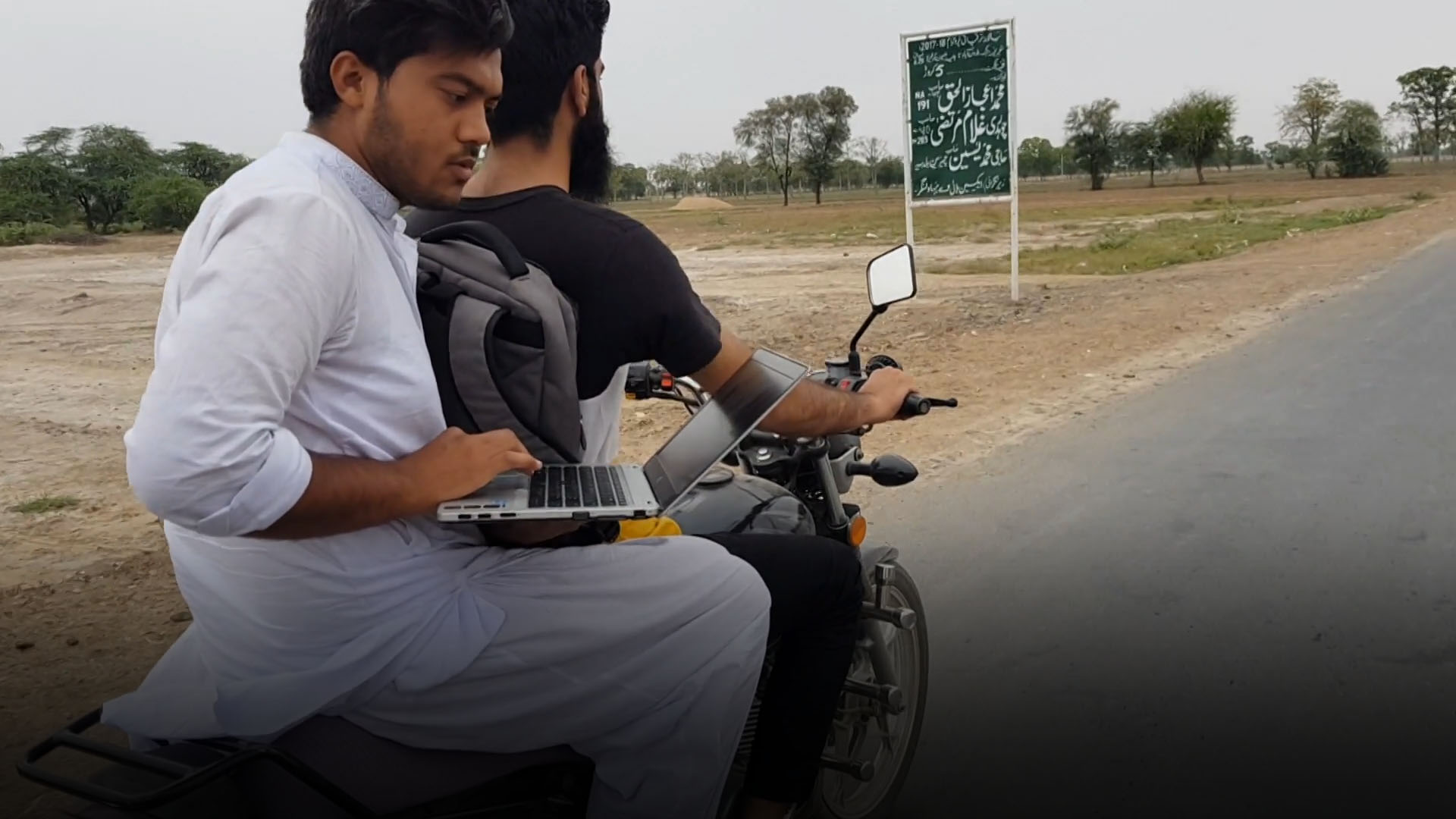
It struck me that these platforms were really proliferating the logic of a call center across many new fields, such as being a composer, a graphic designer, or a video editor. Often there’s a language gap and a major time difference, as well. So, here is Zahid who I worked with—a graphic designer in Pakistan. He told me stories about his work that sounded like he was a surgeon—a specialized surgeon on call, who would get these urgent messages for revisions from people around the world for whom he was doing graphic design work. He told me a story about working on the back of his friend’s motorcycle one day—pulling out his laptop to do a revision as quickly as possible. So, in the process of carrying out this project, I asked him to restage the event and have his friends document it. This really emboldened the process for me of making a reality show or something that had a semblance of a reality show with people who were somewhat averse to it.
And so, I set about casting through these online platforms, and that was quite challenging, in part because everybody said “yes.” Everyone wanted the gigs. They wanted the fees. But it was very strange and incomprehensible just what I was asking for. I would try to communicate as simply as possible that I was looking to make short documentaries about online workers, so they would really have to expose who they are—themselves and parts of their lives and work—through this process. This request was so out of place that it took a lot of back and forth with many dozens of people before I found the people I could work with, because the invitation was not only to be the subject of these short documentaries, but to create the documentary series, create the reality show, with me. So, for example, Zahid, the graphic designer, did the logo that you’re seeing on screen.
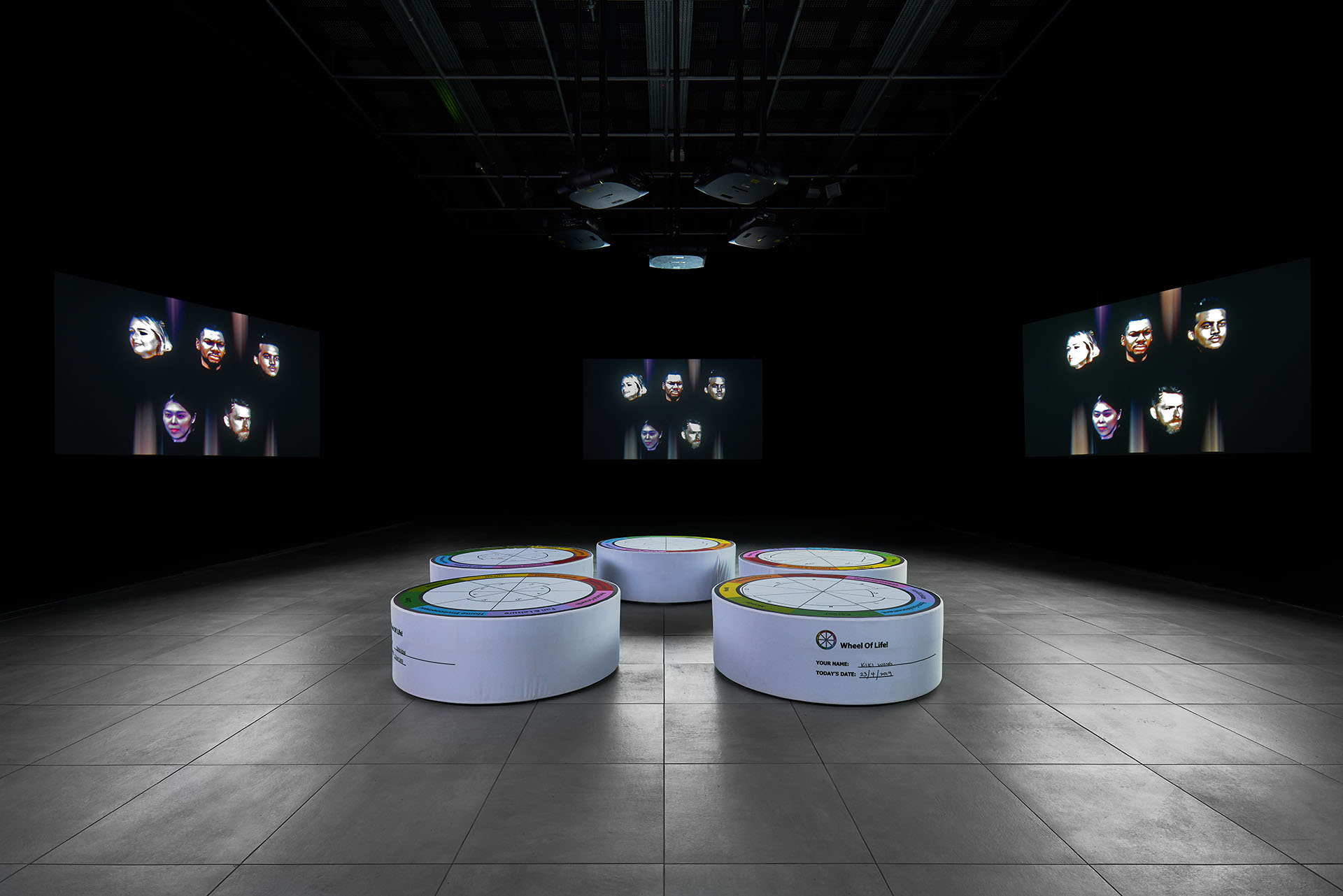
Let’s flip through some images. This is from the first iteration of the installation at FACT in the summer of 2019 in Liverpool. You’ll see that I made seat cushions based on the diagrams that were on the intake forms I had everyone fill out. The invitation was somewhat based on a reality show called Queer Eye that’s popular in the U.S. and beyond. It’s a kind of self-improvement makeover show—an inner and outer makeover show. I was basing our show on that model. I offered everyone life-coaching from a biohacking life coach named Louise Papadopoullos, who had studied at the Bulletproof Human Potential Institute to become a life coach. Bulletproof is a masculine Goop, if you’re familiar with Gwyneth Paltrow’s lifestyle enterprise. Louise is knowledgeable specifically about tech solutions for tech workers’ issues caused by, for example, spending a lot of time in front of the computer.
Here are the five people that I found to work with: this is a social media content writer in Liverpool. I was also looking at how each person came to this more shut-in lifestyle, having most of their interactions take place via the laptop. She had come to it through a severe injury, when she had broken her hip and was bedridden for a year.
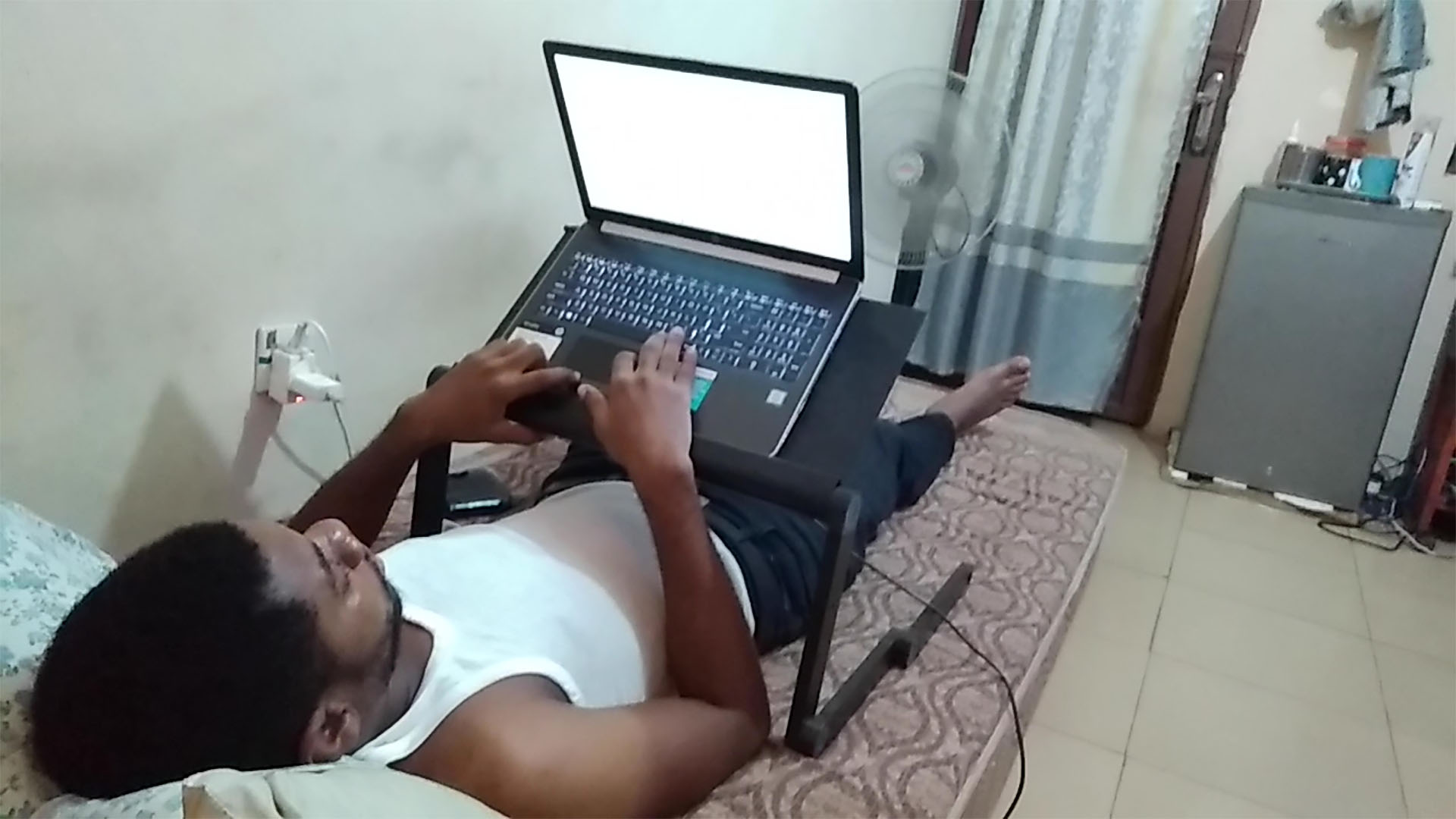
This is Alabi in Nigeria, who is an animator on a whiteboard animation program that shows a human hand come in and draw images on screen, which is often used for the kind of infomercials that explain what type of service your company is offering. Alabi is studying anthropology, but now his dream is to have his own animation studio.
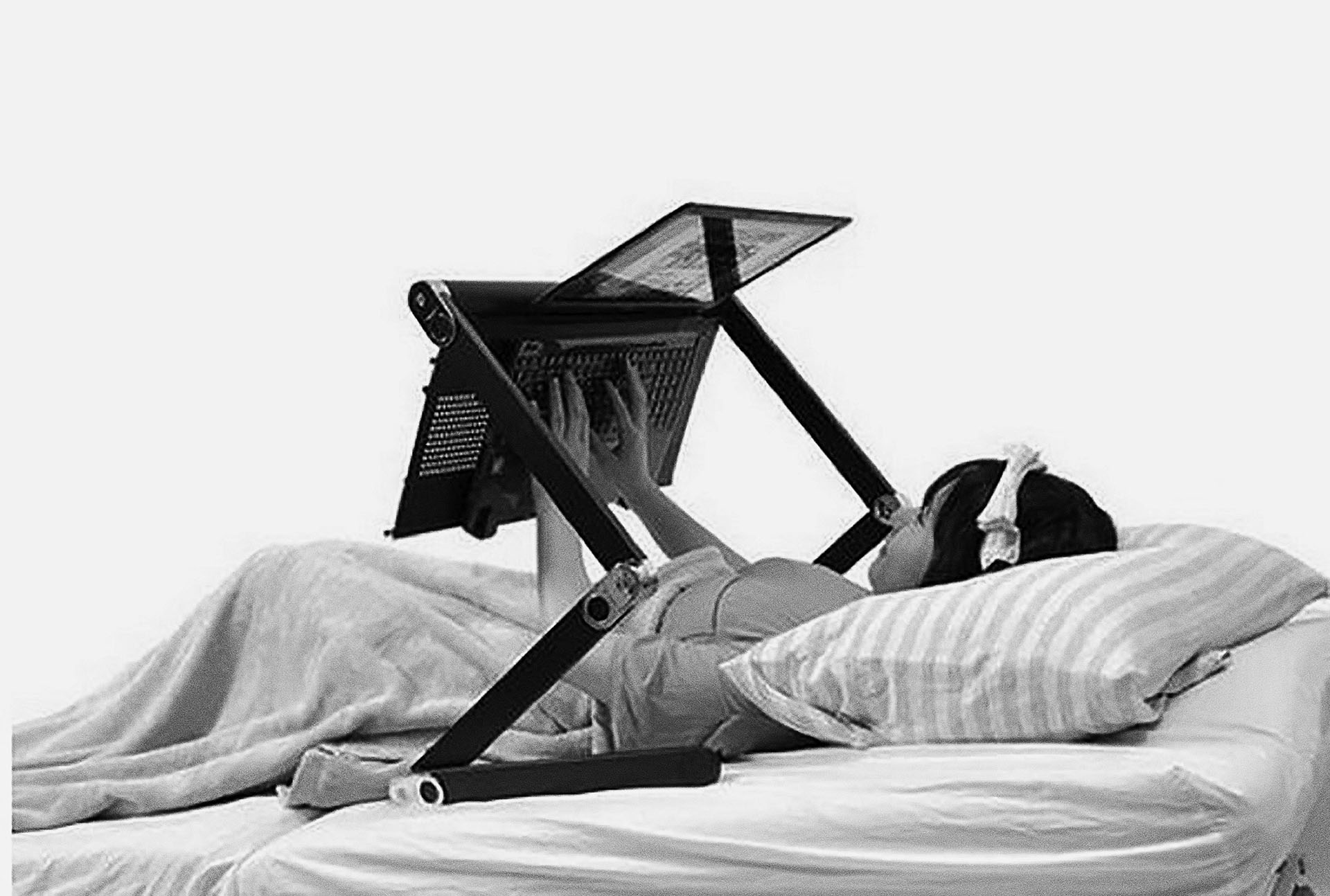
Here is an image from a publication Julia created, in which she shows a desk that you can use from your bed, the same desk that became one of Alabi’s solutions for not having a desk setup, which was hard on his body as he was doing office work from his bed.
This is Cardy. I had to have two people from Liverpool to have a local tie-in, and he was an out-of-work TV-scriptwriter who was doing some ghost-writing at the time through platforms like PeoplePerHour. I had him doing the Wim Hof method, including breath work and cold showers. What he really wanted was to get back to his novel writing. Since he was having trouble following the protocols, we advised him to work on his novel five times a week in the morning for twenty-five-minute “Pomodoro” sessions. Pomodoro method is one of these so-called biohacking techniques, where you work for a twenty-five-minute sprint, then take a five-minute break, then repeat. Research has shown that this optimizes work productivity. We actually had him use what was called a Pavlov shock wristband to encourage this. It is something that’s used to break or form habits. It administers a shock to you when you don’t do what you’re supposed to do. We had it set up to his Google Drive, so that if he got distracted and tried to click out of the document—the novel he was writing—the wristband would shock him.
This is Kiki Wong, who was a forensic scientist whose hobby was singing. She had been working for Scotland Yard in England, working with fingerprint analysis and such. And when she had two small children, she moved home to Hong Kong. Wanting to find ways to work from home, she ended up doing voice recordings for automated voice response systems—that’s like, “Press one for English or two for Cantonese.” So, she was doing a mechanical voice. This analog imitation of AI is one of the topics that Julia and I have been discussing, as it is coming along hand-in-hand with the advance of AI in our lives.
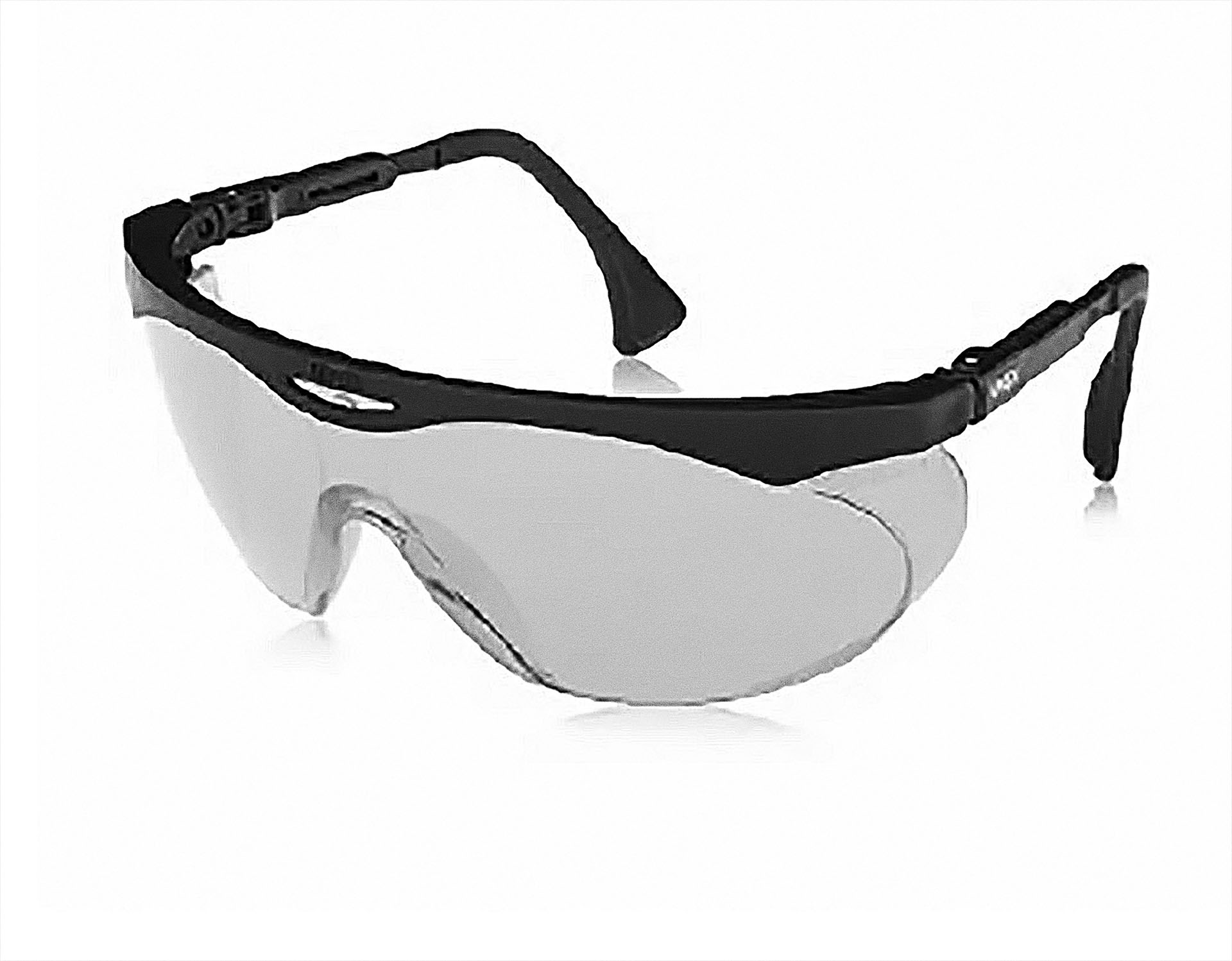
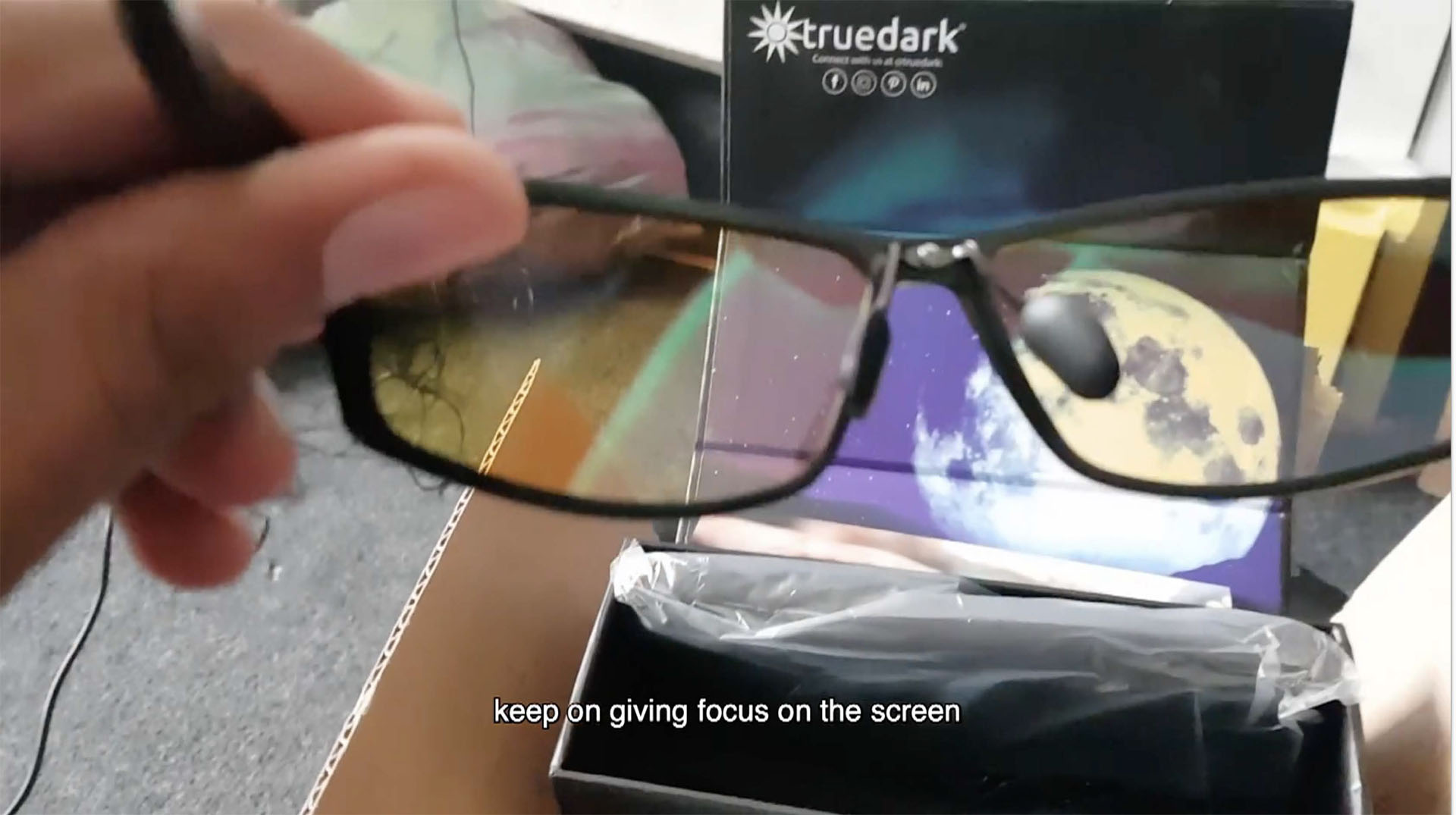
And then this is Zahid, whom I already mentioned. He’s in Pakistan. I’m going to ask you all to watch the first three minutes of his episode now, which will give you the intro, including an introduction to everyone. If you could just watch the first three minutes and then jump to minute eleven and just watch one minute there, you’ll see another device that Julia and I have found in common. It’s a biohacking accessory—blue-light ray-blocking glasses that help prevent eye strain, with the intent of augmenting our bodies to be more symbiotic with our screen lifestyle. And this image is again from Julia’s work, where she had also come across these glasses.
JULIA SCHÄFER Thank you Liz for sharing your work. It’s so interesting how you did this work before COVID happened. Now everyone is in this situation of being tied to the screen. I see myself very much in Zahid, now being a freelance worker and tied to the screen, not having a boss that tells me when to go to work and what to do.
I also came across these UV glasses when I was writing about the work I was doing the past three years and the idea of accessories and tools to help improve one’s ability to work more efficiently, to be more focused, to have better sleep, to develop a more efficient work rhythm. Zahid says in the clip that they help him to be more efficient at work, make more money, be more successful in what he does. So, it seems like this biohacking method really helped him. I think that’s interesting. I don’t know if you mentioned this before, but the idea of biohacking is really to become the better version of yourself. The language surrounding it is similar to the language used to describe machines—this idea of efficiency, performance, optimization, energy. As they also mentioned in the intro, all of the biohacks are based on scientific studies that you can do at home. You don’t need an expensive lab. You can order stuff on Amazon and then just try it at home. The idea is that it helps you to navigate this world in which nobody’s telling you what to do anymore. The fantasy is almost to become an AI or a digital self—the quantifiable self. We record ourselves when we sleep. We record our screen time. Maybe this is almost like a way to become a transhuman—to be something beyond what we are now.
LIZ You’ve written about the work you’ve done in factories for prosthetic devices that have some kind of integrated AI, and you’ve described in that writing how you were asked to track the time each task required, which was very instrumental to scientific management in the early development of the assembly line. That’s something I’ve also been preoccupied with for some time. You touched on something else that I find fascinating about the biohacking trend: it’s all about turning that surveillance on oneself—tracking your own tasks both for leisure and work. We are trying to “make the most of our time” and, in this vernacular, to “upgrade oneself” as if, again, you should regard yourself as a device to be enhanced.
JULIA Exactly. There was one machine, in particular, that I was working with in the factory. Basically, when these implants are being made, they have to be washed a couple of times with special rocks to make the surface smooth, so that when they’re implanted in the body they aren’t felt—so that they don’t open your skin from the inside. We had to pick out all the implants from these buckets with the rocks. Sometimes the rocks were quite small in order to make the smooth surface for tiny implants for the face, for example. Now and then the engineers would come by and ask, “How long did it take you to separate all these little implants from these rocks?” It was about half an hour for maybe six hundred implants. So they brought in machines during the time I was there to see if the machines could also assemble or count all these implants. But because the implants were so small, they fell through. So, the engineers had to improve, again, the machines. And they kept failing, but they said, “In two years we will have a machine that will make your work obsolete.” I felt like a little lab rat, sitting there, counting the minutes and the implants, seeing if I can be faster, trying to compete with the speed of the machine.
LIZ I think something we both have in common is in looking at the insidious dimensions of these pressures to maximize your productivity as if you were a computer, and also harboring a fascination with the potential of these strategies. There are both positive and negative potentials in all these technological developments. And it’s easy to be cynical or utopic. I think what’s called for is more ambivalence—an extreme, heightened ambivalence, perhaps.
JULIA You know, one more thing to add to the story of my time in the factory was that I could really see the effects of automation. Automation is the labor-saving technology by which a process is performed with minimal human assistance. The people who were employed in the factory were mostly men who previously worked in car factories, where they really knew their machines in and out, but the work they had to do was reduced to pressing a button. So, they showed me how the machine worked, and I could also start pressing those buttons. And they were like, “Wow, a woman can do this work!” And I was like, “Yeah—there’s no manual labor, and you don’t have have to lift something heavy. I can press these buttons and look at a screen.” It’s like there was no magic in that sense. The magic happens where we don’t see it, in the micro parts, and that is something I can talk a bit about in the Live Letters project.
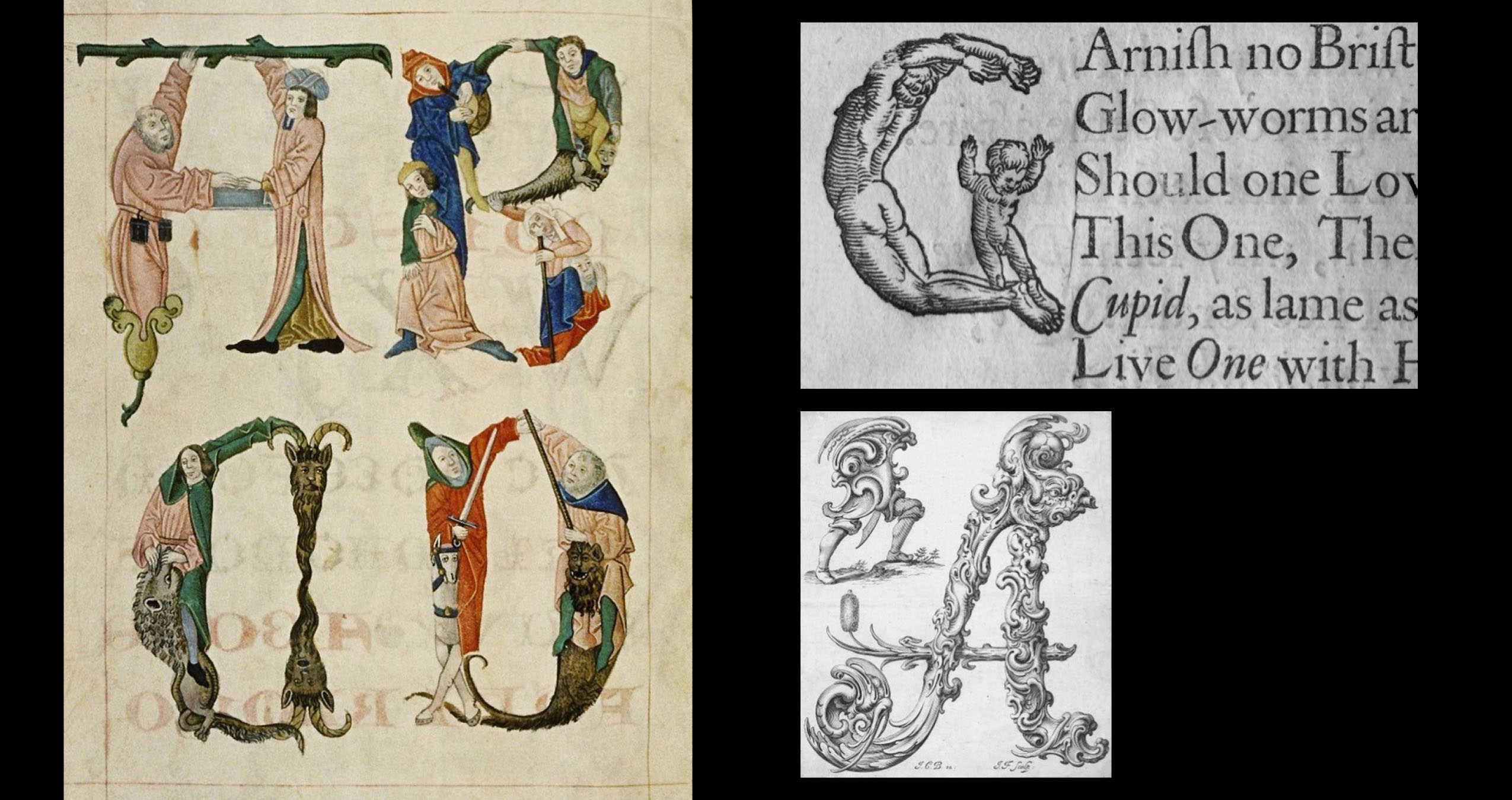
Live Letters came out of a discussion I had with Matthew Carter, the British type designer. I was working as a teaching assistant for a class, and I asked him how his work with the computer has changed his work as a type designer. He said he was really bad at drawing, so the machine or the computer helped him be more efficient. And he was very happy, because, for him, the computer made his work so much easier. As for myself, on the other hand, I had this frustration with being tied to the screen. I was feeling screen fatigue, so I was trying to come up with a tool where the body could be reintroduced to the screen. I had the idea to formulate a tool for writing that would work without the hand or the keyboard, and instead be performed in front of the screen, because so much is lost when writing a message over WhatsApp or other messaging platforms. You don’t have any expressions other than emojis. I was looking at these human initials [from illuminated manuscripts], which I found beautiful and expressive. So, you could read the text, or you could look at the images, and the images would also tell a story. I was also thinking about this idea of encryption—could you hide a message in, for example, a yoga video? Could you discover a message that is encrypted in body language?
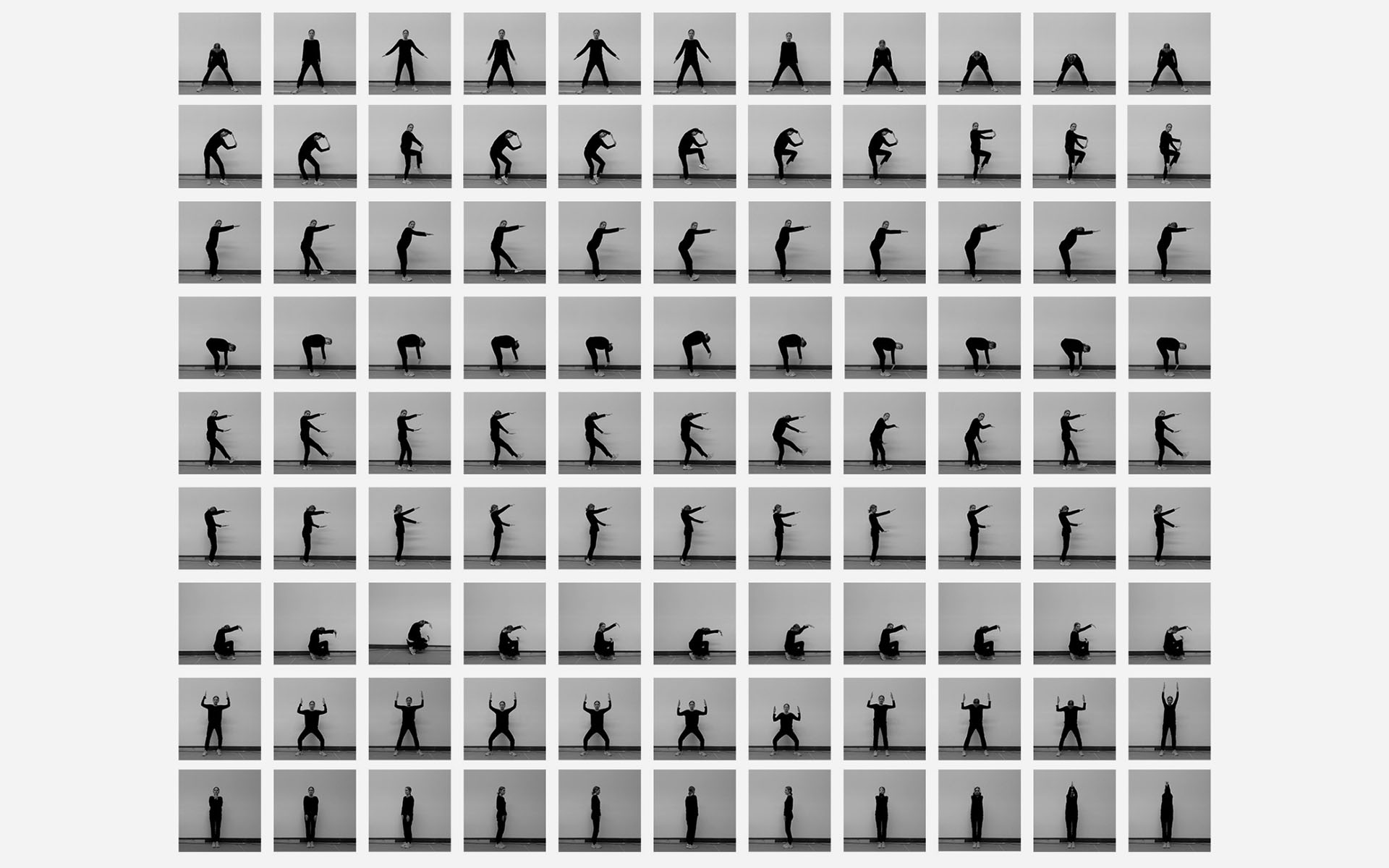
The idea was to use a machine learning tool, here I’m using PoseNet, and combine my camera, so that as I performed a movement, the computer would try to recognize letters. Here, I’m showing a simulation: what you see is PoseNet, that’s a real-time human pose estimation in the browser and allows the model to detect where your shoulders, eyes, or legs are, for example. It’s doing some tests via this super easy to use AI called Teachable Machine, where you can train a computer to recognize your images, sounds, and poses, and then use and export your own machine learning model. So, I had to create my own data set by performing these letters in front of a white wall. The contrast with the clothing is very important. And what you see here is the proof that if we were to do this with an AI model, it could indeed predict a letter. I input an image of mine—thirty-two by thirty-two pixels, minimized for the training data—and it predicted an “H.”
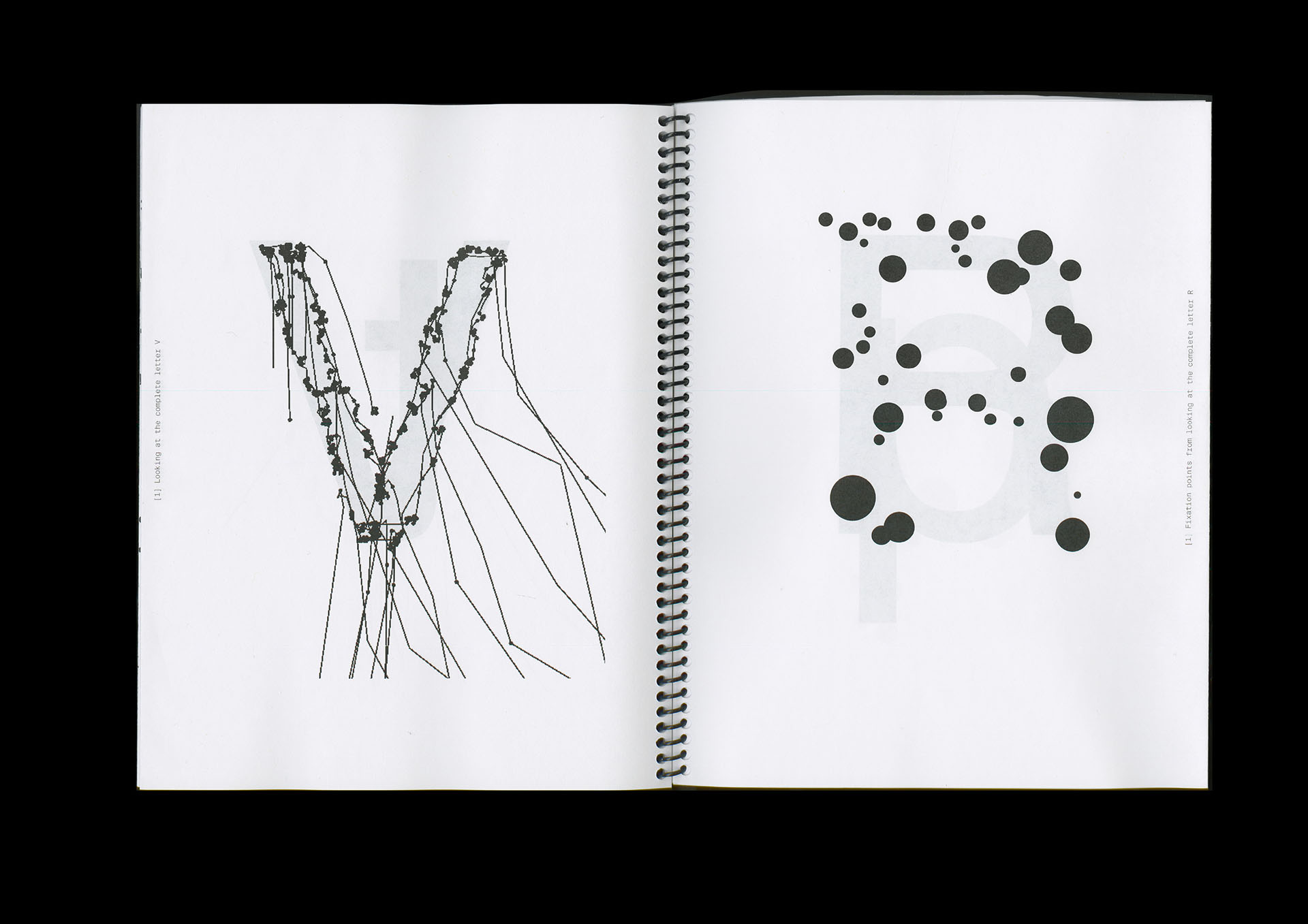
LIZ Do you think you could also quickly explain Eyes As a Tool, where you created the typeface based on how the eyes move?
JULIA Sure. I stumbled upon a book from the 1970s by Alfred Yarbus, who was a Russian psychologist. He discovered some fundamental patterns of visual behavior that he described in terms of eye movements and vision. Long story short, he figured out, as he was showing paintings to patients, that what we look at or what we’re drawn to are high contrast and fine details, such as in expression-heavy areas like the mouth or the lips. We are also drawn to things that move. Twenty years ago, there was an eye-tracking study done with children who are autistic, which found that individuals, children with autism, look differently. They move through the world looking in a different way than do people with no autism. The same is true for schizophrenic people. Having a schizophrenic brother, I was really interested in this—I thought, “Wow, he walks through the world completely differently.” I was wondering if there might be a lab where I could do some tests and figure out a way to use this technology, and I was lucky that Yale has a lab, which you see here on screen—it’s a setup in which you sit very still in front of a screen at a certain distance, wearing a sticker that enables the computer to measure the distance between the tracker and your face.
I was interested in looking at three scenarios to create an alphabet that is drawn by eyes and in understanding how I look at a letter split away from a word. I looked at an entire letter, then at an incomplete letter, and then I tried to imagine a letter on a dot grid. I was using Helvetica as kind of a base, because it’s a typeface that is highly mechanicalized, and the index of the hand is almost lost. I was trying to bring the human back into this process. It took me some time to train, to produce a result that could look like a letter. I also did some fixation point studies, to see where the eye looks, to determine which parts of a letter the eye needs in order to recognize a letter. And then I created an alphabet out of these fixation points.
LIZ When I’m looking at your work, especially at this project, I think of how these strategies approach the human as if one were a machine or an alien to be decoded. It’s asking, you know, “How does the eye function in both erratic and efficient manners?” I first came across this kind of eyetracking technology nine or ten years ago in a book called Emotionomics: Leveraging Emotions for Business Success [Dan Hill, 2009] that was about replacing market research methods of focus groups and interviews with a Webcam to track micro-facial expressions and eye movements.
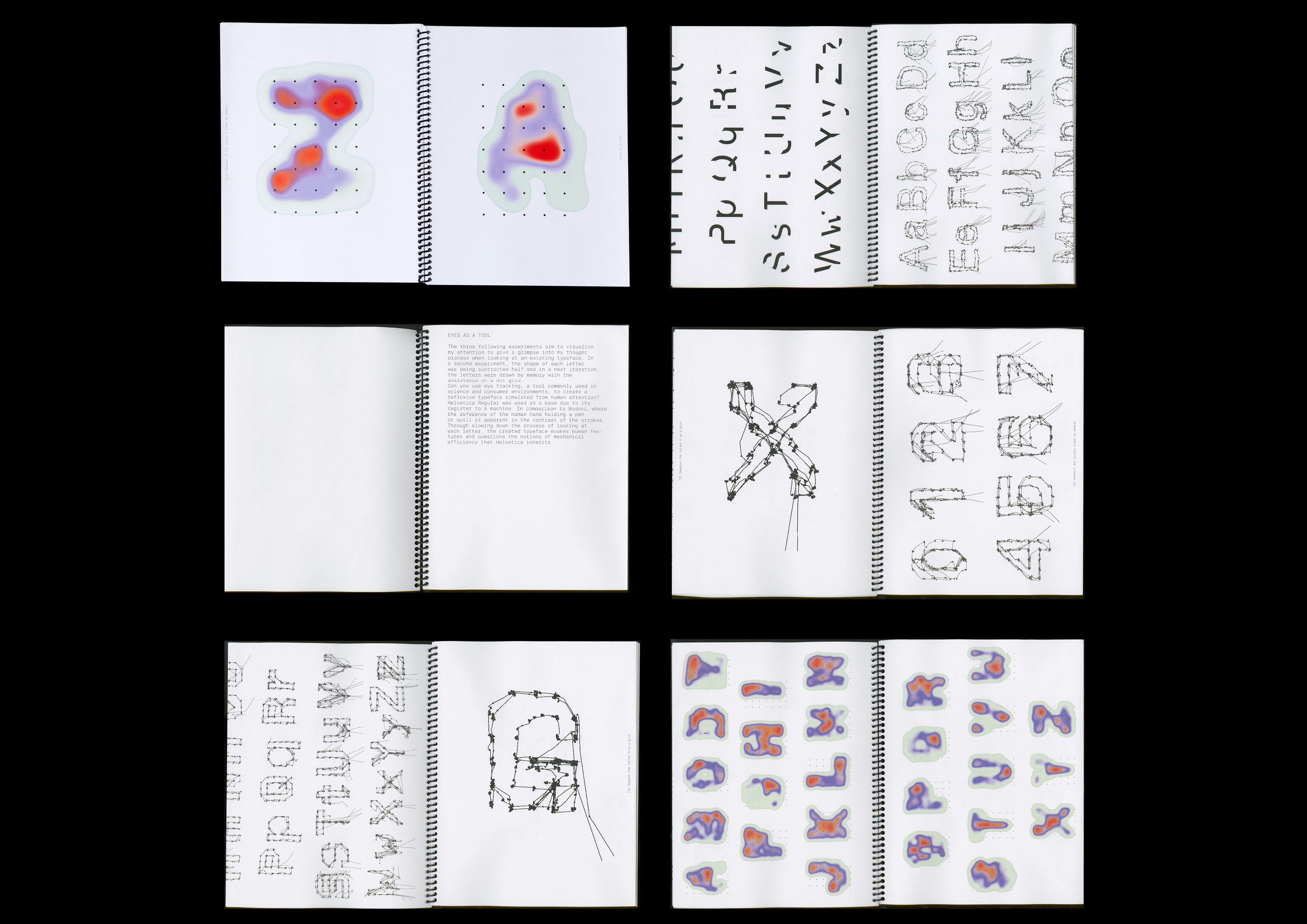
JULIA Yeah, it is a research method that is used for interactive designers at companies like Google in order to understand the pattern of a user going through a Website so they can optimize where to place what in a design. It’s also a tool for optimization, of course, as it is for research—psychology or language research.
LIZ You brought up analogies that have been made often recently about the perceptual styles or abilities of someone who is autistic or schizophrenic proliferating through the logic of the device. In many cases, those who came up with game theory or who came up with code to begin with, it seems, had a streak of autism or Asperger’s. And there have been questions about whether our device use and our computer reliance instills in us a more autistic, un-empathetic way of being.
JULIA One thing that was interesting with the eyetracking is that I had to go through a lot of steps in order to be able to use this tool. The lab closely monitored the data collection to ensure that I only used my eyes. In order to have other participants, I would need additional legal paperwork.
LIZ Similarly, after already having a forty-page contract with this institution that funded my reality show, they started to get uncomfortable with the ethical implications of me providing what could be seen as therapeutic services to people, by giving them a life coach and interviewing them frequently myself, and giving them a psychic, as well, and sending them devices to improve or optimize their behavior in life and work. I never signed it in the end. The project had already gotten started, and I thought, “This is too much—I’m supposed to take on the responsibility if anyone gets upset emotionally later?” But it’s interesting how the litigious dimension comes in more and more, also with these disclaimers that we’re constantly agreeing to online. Again, back to this issue of empathy and ethics, this was something that I was very taken with in terms of the dashboards and statistics provided by platforms like Fiverr and PeoplePerHour and Upwork to their workers.
JULIA You mean, as you show in the series, that if you’re a success, you’re rated by five stars? Now you’ve got to make more money—
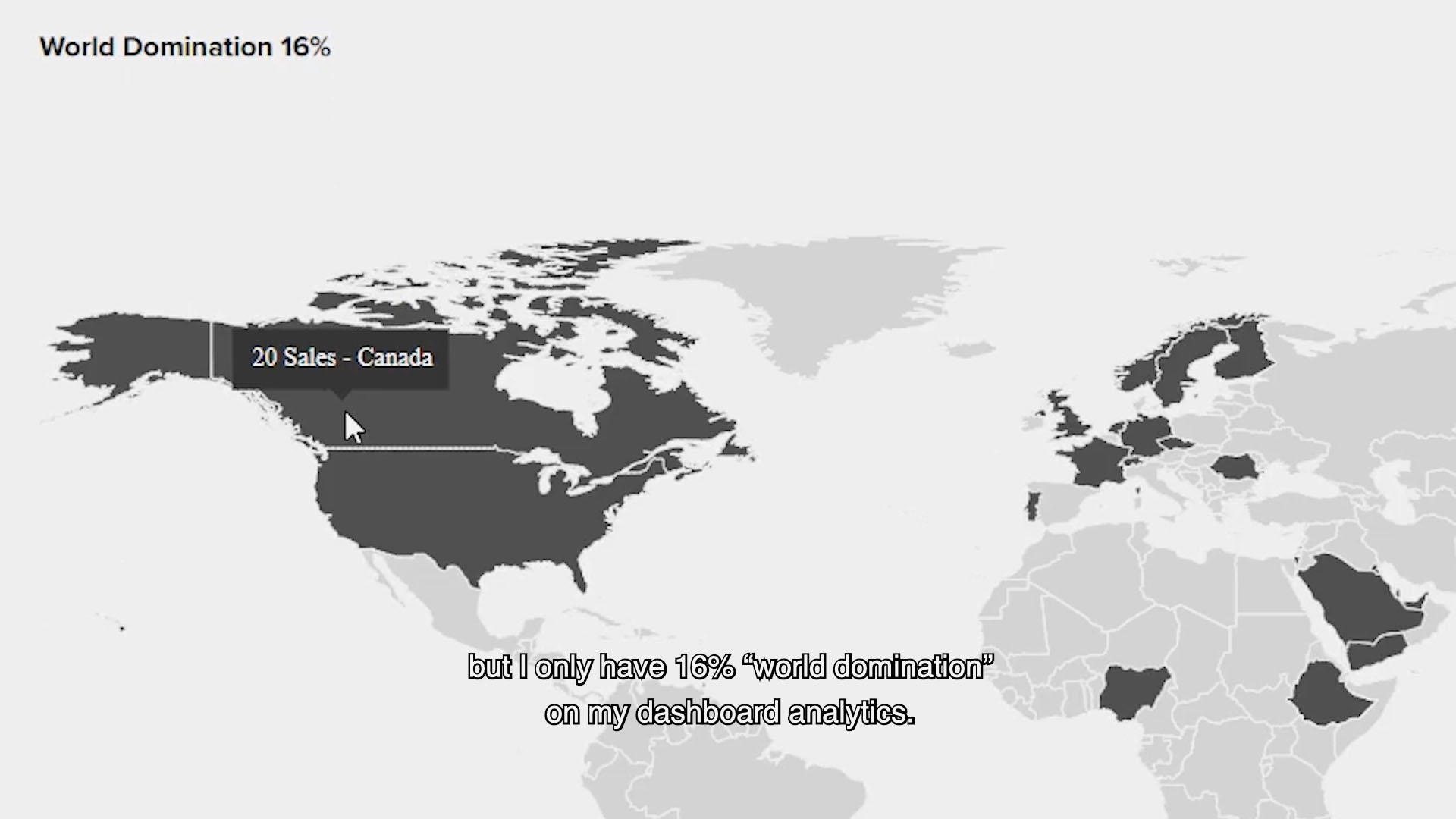
LIZ If I’m the client, on my end, I just see star ratings and such—it’s simpler. But on the worker’s end, they have all these statistics. One of them was called “world domination”—so that the gig worker could feel like a CEO in their boardroom, and they could see where on the map they were getting work and where they had to expand to. This gets to the more insidious dimensions of this endeavor of the gamified platforms, where, I think, to get workers, the platforms advertise a false sense of agency that you could be your own boss, and you can be the entrepreneur to “expand your growth,” your world domination. Whereas, in fact, your fees are based on making yourself available 24/7.
Really, these platforms outsource the idea or the role of the boss to algorithms. And I think you could probably consider that to be an “AI boss,” though human-assisted, because they keep updating how they provide these statistics that then determine how much money someone makes, what their ranking is, how frequently they are shown when someone searches for a graphic designer. If you get sick or have an accident, there’s no human with empathy to appeal to. Maybe in the past, your boss was not so empathetic—some bosses were empathetic, some were not! But bosses were biased. So, on the one hand, the argument is, “Oh, this algorithm, or the AI, is unbiased,” but on the flip side, there’s no empathic being to appeal to if you get sick or have a death in your family.
JULIA Yes, Nikki [from IRL] was mentioning that she’s very lonely, and she wanted to work on seeing more friends, having time to see friends in her schedule and to work on that with the therapist. This idea that there is no more boss, and if you don’t work, you don’t make money, that if you’re driving an Uber, you don’t go driving, you don’t make money—
LIZ —this is a libertarian, Silicon Valley idea of personal responsibility: “Social mobility is within your reach. It’s up to you.”
JULIA Exactly. I stumbled on all these articles and videos about how to live like a CEO—he or she gets up at 5:00 a.m., and is doing a thirty-minute cardio workout, and then gets her shake. It’s a dream of becoming almost machinic, becoming this perfect human that is always able to work. What really struck me in the IRL series is that they talk so much about this “freedom.” It’s a liberation to work on these platforms. And on the other hand, they never take any holidays. If they need to see a doctor, they have to push the work, or they can’t finish the work. Sometimes they don’t get paid.
LIZ You don’t have any benefits. They can refuse to pay and you have little recourse.
JULIA It’s very appealing on one hand and very dark on the other hand.
LIZ There are oppressive potentials and actualities to it. I started off seeing it in this more insidious light, and then, in the process of doing this, I had to face facts that for someone like Alabi or Zahid, this was improving their lifestyle. Arguably, they were making more money and were feeling more self-reliant than they had before they did gig work. Zahid was at this technical school called the Virtual University, where everything was remote learning. He would go to the computer lab and learn remotely from teachers elsewhere. And he talks about seeing people come to interview for a janitor position at the University—most of the people he saw interviewing for that job were alumni from the technical Virtual University. The janitorial job paid $70 a month, and he was like, “But I can make that from one gig.” He was really wanting to spread the wealth, so to speak, and help others—his classmates and others in his community—to do this online gig work. Although this work entailed frustrating unfair incidents, it was sparking the production of a larger creative class in the developing world. I thought often about people like you and others I know who are very sophisticated, conceptual graphic designers for whom, I imagine, these gig platforms represent a degradation of the medium to have clip art serve as online logo design, for instance. On the other hand, it’s democratizing the tools of production and methods of remix, and it’s offering the possibility of becoming a producer to many more people, albeit via the insidious advertising of becoming an Elon Musk—becoming a workaholic who is chained to your computer and must be available at all times. It’s multifaceted.
JULIA Yes, I also wonder what the development of AI means for creative work. I can imagine that a lot of the work that is now akin to manual labor, like switching things up in a program, or let’s say you produce a logo with twenty options from which someone can choose one—currently we’re creating those twenty options. But if an AI could just present to me all the options—10,000 options—I say, “I want it in this color, and I want this symbol, this typeface,” then I could just pick in the end. There is going to be a significant change also for people who work on Fiverr now, because the work is so mechanical. In that sense, there’s just not that much creative labor that has to be done once it comes down to getting an animation right by picking the correct elements.
LIZ Right. And so, again, that’s the ambivalence there—if automation and AI can step in to to reduce the unnecessary, rote labor for you and improve—
JULIA —I will have time for other things.
LIZ And, you know, then there’s also that dream, that fantasy that work will become obsolete—that we can be exclusively the idea producer, the brain, and have automated beings and computers carry out all of the rote labor. That puts people out of work, though, is the flip side, right?
JULIA Are you still in touch with the people from IRL, and are they still working on these platforms?
LIZ I have kept in touch with the people, especially with the beginning of the COVID crisis in March. After being in close contact with them for months last year, I wanted to know how they were doing, and I also recognized that the pandemic was throwing all of us into a lifestyle that was more akin to theirs. I primarily produced the reality show via Zoom. Louise, the life coach, already was doing all her work via Zoom. And I was directing them to film themselves in different ways via this communication method that we’re on right now, and we were considering all these issues, learning how to make the most of an isolated life.
JULIA You also sent them little tools, so that they could place the camera differently.
LIZ Yes, I was sending them iPhone tripods along with their devices, for instance, and directing them to film themselves from various angles. But I also have been in touch with Kiki, who’s the forensic scientist/voiceover artist, because she has started a business along with her husband, which also relates to your Eyes As a Tool project. It’s a micro-facial expressions consulting firm. That’s what her episode is about—how she really wants to get that business off the ground. She has been successful with this, and I’m starting to work with her again, strangely, at the invitation of a judge in San Diego, to come up with some educational materials and advice for judges who are struggling to adapt to trial proceedings and hearings via video conference. A lot of what you brought up in the Live Letters project has come up as a challenge for judges who are presiding over the virtual courtroom, where they’re missing body language, they’re missing the sense of a person—of someone’s aura and maturity. So, a judge got in touch with me and asked if I’d want to develop some videos or presentations to help get judges up to speed. One idea I came to because the judge mentioned that assessing witness credibility was an issue, was to bring Kiki into the project to see if she might be able to offer some tools for learning to identify micro-facial expressions, which she uses for deception detection in her work. It is also about eye movement and the small mimicry or lack thereof that we do with one another in our micro gestures. This gets into tricky ethical territory, which I’ll have to navigate.
JULIA You’ve also mentioned that they have basic needs, too—their eyes get tired, they don’t know how to sit anymore. These are practical things. Someone who has never done that, has never spent that much time working on screen, struggles with it.
LIZ Yes. I’ve been working on some grant proposals to do a five-part series for judges and people in the U.S. who are participating in Zoom or video conferencing proceedings, to help them prepare themselves as best they can. The judge who originally contacted me brought up what you mentioned—that she’s getting eye strain and neck strain. Her fingers hurt. And I said, “I know! I have exactly the biohacking solutions you’re looking for—one episode can be a wellness one.”
ANGIE OK, thank you Liz and Julia for sharing your work with us. I want to bring in the audience now—if all of you would please turn on your video feeds—and if you have questions, give an indication or just jump in, and be sure to turn your mic on.
JONATHAN ZONG Thank you, Liz and Julia. That’s a fantastic conversation. I want to press on ethics and also ambivalence, because those were really great places for this conversation to get to. I find one of the most interesting aspects of the project is the relationship between parody and sincerity that I picked up on in some of the interactions. Like, when Zahid in the clip that we watched is opening the box, he’s acting very excited, like, here’s this new hack, and he can’t wait to try it. And you have this critical framing of the project about the gig economy and labor, but you’re also necessarily participating in it to create this series. So, you’re providing these biohack things for people to try—though the term “biohacking” might be a little overbroad here, since things like the blue light glasses are uncomplicated, they’re more like a prophylaxis, like they’re supposed to prevent harm to your eyes, whereas the thing that shocks you on your wrist is very clearly a kind of disciplinary and punitive technology that is used in Amazon warehouses. You have algorithms that fire the lowest performing people every week, right? So, when someone like Zahid uncritically embraces these things, I wonder what your rhetorical position is. Are you here to just document this when it happens, or do you have a critical stance in the end?
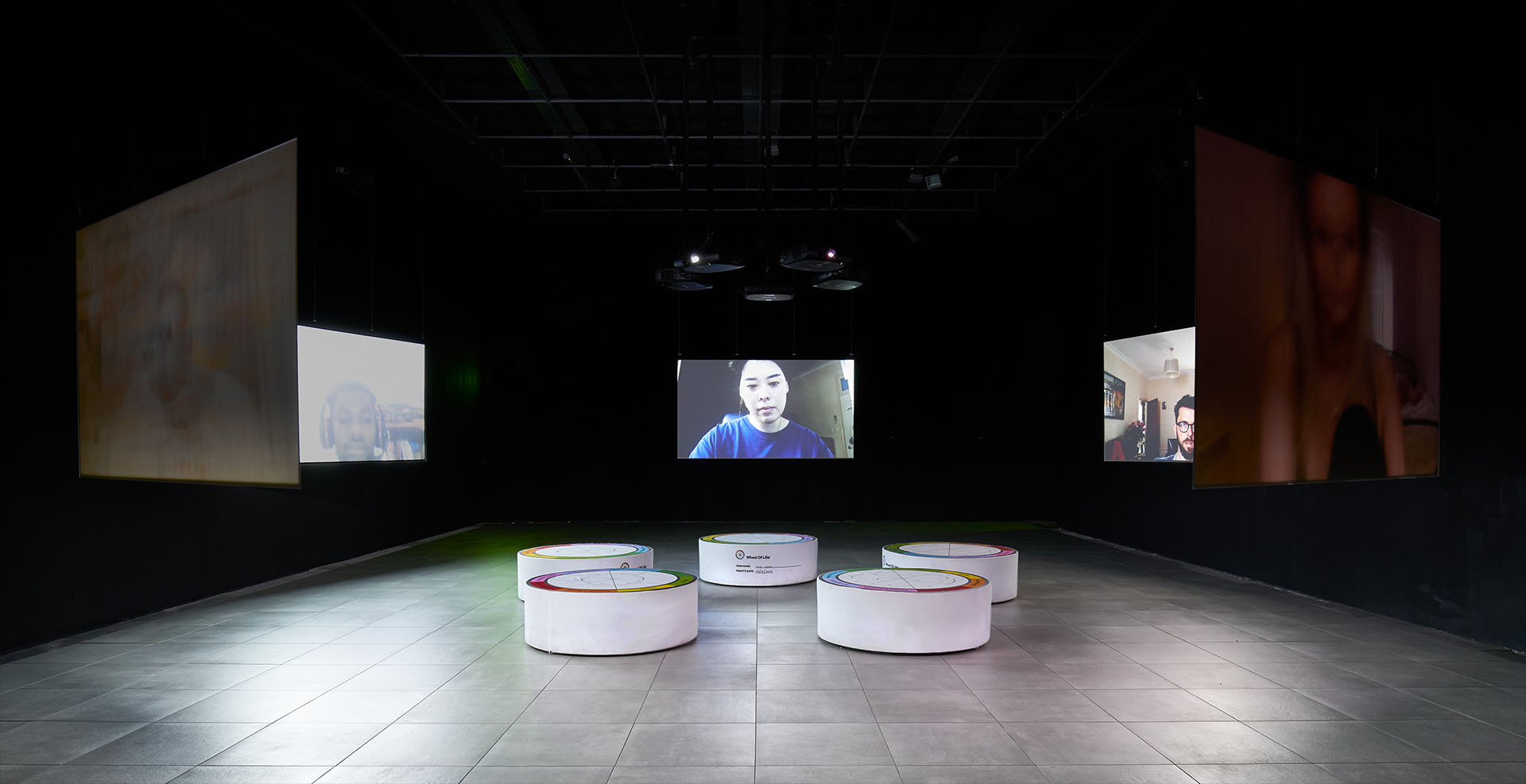
LIZ I do as a person. And I do think there’s some unfinished business with this project. Because it was more documentary than anything I’ve ever done, and of course, I was very heavy-handed as the documentarian, I feel uneasy about how “positive” some of the episodes turned out. In a way, the critical framing only works when you see it overall in the context of the exhibition. Then, if you see the episode with Nikki, for example, who comes across as more of a typical participant in a reality show in how she looks and speaks, and then you see Alabi’s episode right after that, there’s a dissonance in the approach. I asked him to use a device called HeartMath, where he was learning to control his heart rate to prevent stress and to be able to keep himself calm so that he could sleep whenever he needed to, because there are a lot of power outages where he is in rural Nigeria. And these bizarre “cave man diet,” Silicon Valley hacks like taking twenty-minute power naps and never really sleeping were strangely appropriate for him in a situation where he sometimes needs to work whenever the power goes on and sleep when the power goes off, sparingly using his generator only when necessary. So, I think that perhaps, if you watch that episode, that the criticality and the dissonance of this positive framing is brought into higher relief against the lived experience of these realities being represented. I should also say that in the exhibition, it’s basically a binge-watching scenario, where one episode plays after the next. Everyone has their own screen. And while you watch one episode, you have what is almost a screen saver of the other four characters, each on their own screens, endlessly working at their computers. So, you see them standing at their computers. You hear their typing. You hear their phone ring or their child or dog interrupt. There is, I think, a different framing and quality to that exhibition scenario. But I also had hoped to make this somewhat more pop and potentially get it out there on a bigger platform. Thank you for the question—you touch on something I’m uneasy with. I’ve worked with different therapeutic methods over the last four years or so, and, in this case, while the whole project was delayed by about four or five months, I had already reached out to the life coach, so I decided I would start working with her myself and do my best to suspend disbelief, because I was going to ask other people to do this sincerely. I think that shows in the outcome. I don’t know if that answers your question, but it’s a problem or an unresolved thing I have with the piece that I both feel proud of and uneasy about. Again, thank you so much for your question.
ANGIE Do we have any other questions—maybe from Sandberg students?
LIZ I have a last question for Julia about your take on AI in terms of what we’ve brought up about the positive and sinister potentials for substituting human workers and human soldiers. When I was developing this work, I got interested in Stewart Brand and started reading a biography about him. He’s the one who started the Whole Earth Catalog, which is now considered a precursor to the World Wide Web, and there’s a biography I read about him and his work called From Counterculture to Cyberculture [Fred Turner, 2006]. I listened to some lectures of his, as well, and one of his utopian visions of AI is that it will replace all soldiers. In the end, we’ll have robotic soldiers fighting other robotic soldiers with far fewer human and civilian casualties. You brought up the idea of AI reducing the amount of rote labor, and, as we’ve touched on, this also pushes people out of work or reduces fees for sophisticated graphic designers. It puts factory workers out of work, and so on. I wonder what ambivalence you may feel about your fascination with it.
JULIA This question makes me think of another project that I’m involved in now, which is an AI opera. It’s an opera written by an AI, GPT-2, which is a generative, pre-trained transformer that can generate new text based on existing text. What has been interesting there, is that the machine provides so much poetic content that evokes emotions, yet other parts are just rambling words that don’t really make any sense or feel connected.
LIZ This is the one about Alan Turing, right? From what you’ve told me, it starts with a proposition of his, and then the computer just responds, and one of the responses that becomes a refrain is, “Alan Turing is an unethical man.”
JULIA Yes. The overarching idea there is that the piece acts as a giant Turing test. In case you’re not familiar with the Turing test, it is a matter of quizzing an AI to determine whether you’re talking to a computer or you’re talking to a human. Our role is basically just picking the interesting parts that come from the machine-generated text. So, there is this collaboration, and I think that’s what I’m personally interested in—the collaboration with the software in trying to see where the human comes back.
MAJA CHIARA FABER I have a question for Julia about this opera. Is it an algorithm you wrote, or is it an open source algorithm?
JULIA The language model GPT-2 was invented by OpenAI in Silicon Valley. It’s a company that Elon Musk founded with some other peers, and then sold. They were helping us to feed this machine with all the writings from Turing. It’s a language model. It’s trained on the language of Turing’s writing. This is just a potential script for the opera. It’s not tied to music. So, these are two separate things. The team that is working on the opera decided to work with an AI in order to create the script for the opera. The project is still at its start. Hopefully it will be out sometime next year. The goal is to perform in London or in Oxford, where all the archives of Turing are kept.
LIZ After talking with you about the Turing project, Julia, I began looking up machine learning models because that was something that you had mentioned, and from what I understand, the two main categories are supervised and unsupervised. “Supervised” means there’s human intervention in how the AI learns. That made me think of your interest in the human aspect—the intervention that keeps the AI focused on an interesting or ethical path.
JULIA Five years ago, when I went to undergrad, there was no discussion about trust and ethics that I was aware of in AI, but in the last five years, it’s become a must—we need to talk about these biases. I think it’s important to form a vocabulary around that, so as to understand what’s happening and to have an opinion—to be able to argue and to see the unethical side, to understand that this is not “clean” data. This is not a democratic system as it is sold.
LIZ Right. A human dialogue must be maintained, because both arguments—that humans will keep the AI ethical or vice versa—don’t hold. I brought up the Stewart Brand position on AI soldiers, because his argument is that AI soldiers will be more ethical and kill fewer civilians, so you don’t have to worry about an Abu Ghraib with AI soldiers, because they won’t turn towards a sadistic—
JULIA —it’s already failing. I mean, we’ve seen that. Especially with ML, it really depends on what data the model is trained on. Out of curiosity, I used a preexisting text-to-image model to output a specific letter, and somehow each letter looked like a bathroom—like a sink or a toilet. I realized the data set was completely trained on the interiors of houses. So, I would get an “A” that was like a warped sink. It became clear that the trained data was not what I was looking for. But what about instances that aren’t as clear?
LIZ That fantasy of the seamlessness that you touch on and bring up in your work often is impossible, because there is always a human feeding biased datasets and teachings. There’s always a human who is the teacher or instructor of the learning model.
JULIA Exactly—the one deciding which models to take from—and it’s surprisingly easy to do this.
LIZ It’s a fantasy that we’re going to create a sanitized, ethical Artificial Intelligence that can do that wrong.
ANGIE I want to ask a final question, a bit of a non sequitur, but since we are an art school and an audience of artists and we talked a little bit a few minutes ago about framing and context for the presentation of In Real Life, I wanted to ask you how relevant to you or to the work is the categorization of it as art or, for example, as a reality show? What difference does it make? And, somewhat related to that—to the extent you’re aware, what were the judgments, feelings, conclusions of your cast when they saw the final outcome of the project they had been participating in?
LIZ They were primarily excited about the heightened production level that was eventually brought to it. I was as clear as I could be about my two-fold take on the gig platforms and the biohacking—that there were benefits and sinister dimensions to it. Everyone saw multiple edits, and in the contracts I had with each person, they had a right to give feedback and ask us to take parts out. So, I think there was a strong level of trust in that respect. The only person who was unhappy with it was the psychic, who felt, I think, that he wasn’t as present as he expected to be or that it diminished his practice, that it gave a superficial presentation of his practice. But in truth, he met with each person twice whereas everyone had five sessions with Louise, the life coach, and I then followed up with them as their accountability partner. That’s part of this kind of life coaching: the coach offers accountability partnership and follows up on whether someone is adhering to the actions and goals they set forth for themselves. In this case, since there were so many people, I was their accountability partner, encouraging them and checking in.
Regarding context, I tend to agree with that Marcuse line of thinking: “art as institution.” Context is everything when it comes to classifying something as art or non-art. And so, as I described the installation, I think that the installation has a much more critical framing than if you see these episodes individually online. But, again, some episodes are critical and some are more positive, perhaps. I did really have this fantasy that this would be seen by Silicon Valley folk, so they would have to confront the ramifications of these gig platforms and what they’re setting forth, because it is a self-purported utopian crowd of micro-dosers and meditators.
ANGIE Is it fair to say that, strategically, art—as an institution—is a platform for you to reach an audience, but what art itself wants as an institution or conversations that are confined to that institution about what forms art takes are not of great relevance to you, at least in the development of this work?
LIZ Yes, I would say that, especially because I had my sights set on reaching a wider public with this project, which I have yet to do. In this case, I think the field of art became a means to produce this. Of course, at the end of the day, there is a conceptual dimension to my take up of the reality television model, and I chose to apply it to the most boring lifestyle and labor of being chained to one’s computer. So, I really kind of set myself up for a challenge by approaching this undramatic, unbombastic, not-so-entertaining laptop lifestyle—the idea to make something entertaining and controversial, conflictual out of these scenarios was a Sisyphean task. I had to face facts that if I really wanted to make a pop reality show, it could not be about this topic or about these people.
ANGIE Thank you, both. We really appreciate you sharing your work and letting us be flies on the wall for this conversation.