Auriea Harvey
in conversation with
Elio J Carranza
The following conversation between Auriea Harvey and Elio J Carranza occurred via Zoom on Saturday, July 29, 2023 at 8:00 in New York, 14:00 in Amsterdam and Rome.
Download this conversation as a PDF
Auriea Harvey has been working for three decades in a range of media from interactive game design to virtual and tangible sculptures. She lives in Rome.
Elio J Carranza, currently based in Amsterdam, is a recent graduate of the Sandberg Instituut. Their moving image and sculptural installation work is rooted in interactive game development.
ANGIE KEEFER I typically begin these conversations by introducing the participants to each other, but in this case, you two are already well-acquainted, having met in in 2019, when Auriea became the head of the new games department at Kassel University of the Arts. Auriea, as you know, Elio subsequently pursued an MFA at the Sandberg, where I teach, which means you and I have the good fortune of sharing a connection to them. I would like to learn more about the department you run in Kassel, Auriea, and about the work you did when you were there, Elio.
AURIEA HARVEY When Elio and I met, it was pre-pandemic, and I had not been at Kunsthochschule Kassel very long. It was very interesting for me to take on the position of building a department around my philosophy of games, which was interconnected with other forms of media, and—visual communication being the overarching department—with the idea that video games were an art form or a culturally important and significant form of media. I approached it not as teaching games per se, but as teaching games as an interconnected form, which is why I didn’t change the name from games to “experimental media” or “interconnected practice of digital whatever.” I didn’t give it a new, obfuscating name, because to me, “games” already was this interconnected form. Coming into this from painting, from sculpture, Elio—you were a perfect fit. Exactly what I’m asking students to do all the time is to bring all those things that interest them, all those practices that they have, to the form of games and not the other way around. Not to think of this as games first, and then go, “Oh, well, I have to make a form that is a game,” but to make a game from the place that any artist makes any other type of work, which can come from anywhere, including games.
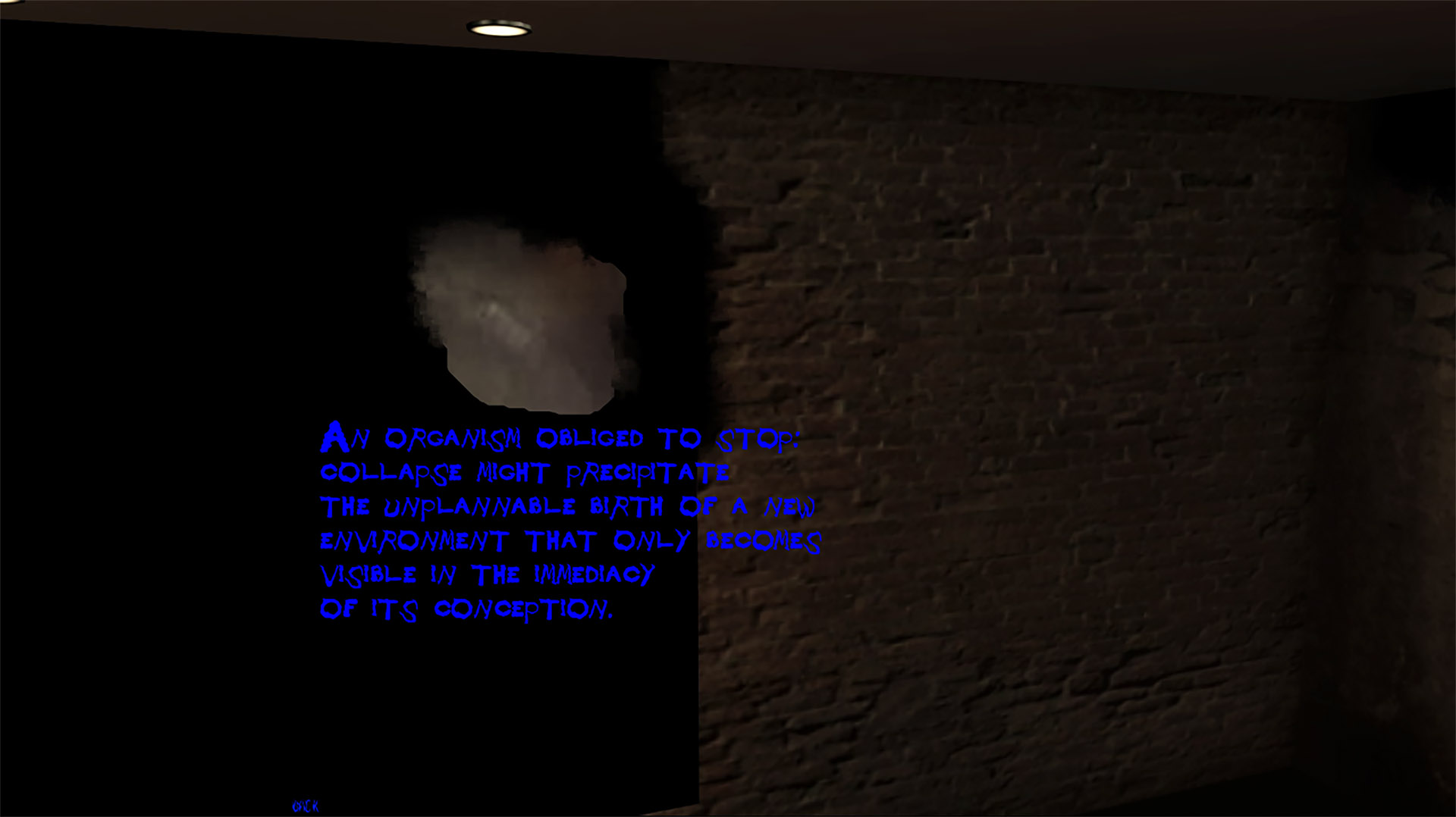
ELIO J CARRANZA As you know, I was not a regular gamer when we met, never having played traditional commercial games, though the topic of play was there in my work. I had started in the painting department, then moved into performative sculpture. In the games department, I was able to approach games in a more experiential way, to learn digital image-making techniques, and to use them beyond classic video editing. I made the kinetic novel Multiple Capaciousness (2020), a click-through game, working with polyphonic voices and sound in an interactive digital setting for the first time, and I taught myself some coding to customize the Renpy game engine. This work was highly personal—an attempt to formulate a visual grammar to express the fragmented experience in a state of CPTSD [complex post- traumatic stress disorder] and explore the potential of softening body boundaries in the healing process. While there was a deep focus on physicality, at the same time the work was speaking not so much about the body as it was trying to speak to the body through the digital realm, especially as it was played on computers at home during the pandemic. Since then, over the past couple of years, I’ve merged this digital practice with tangible materials like metal, glass, ceramics, and even DIY electronics.
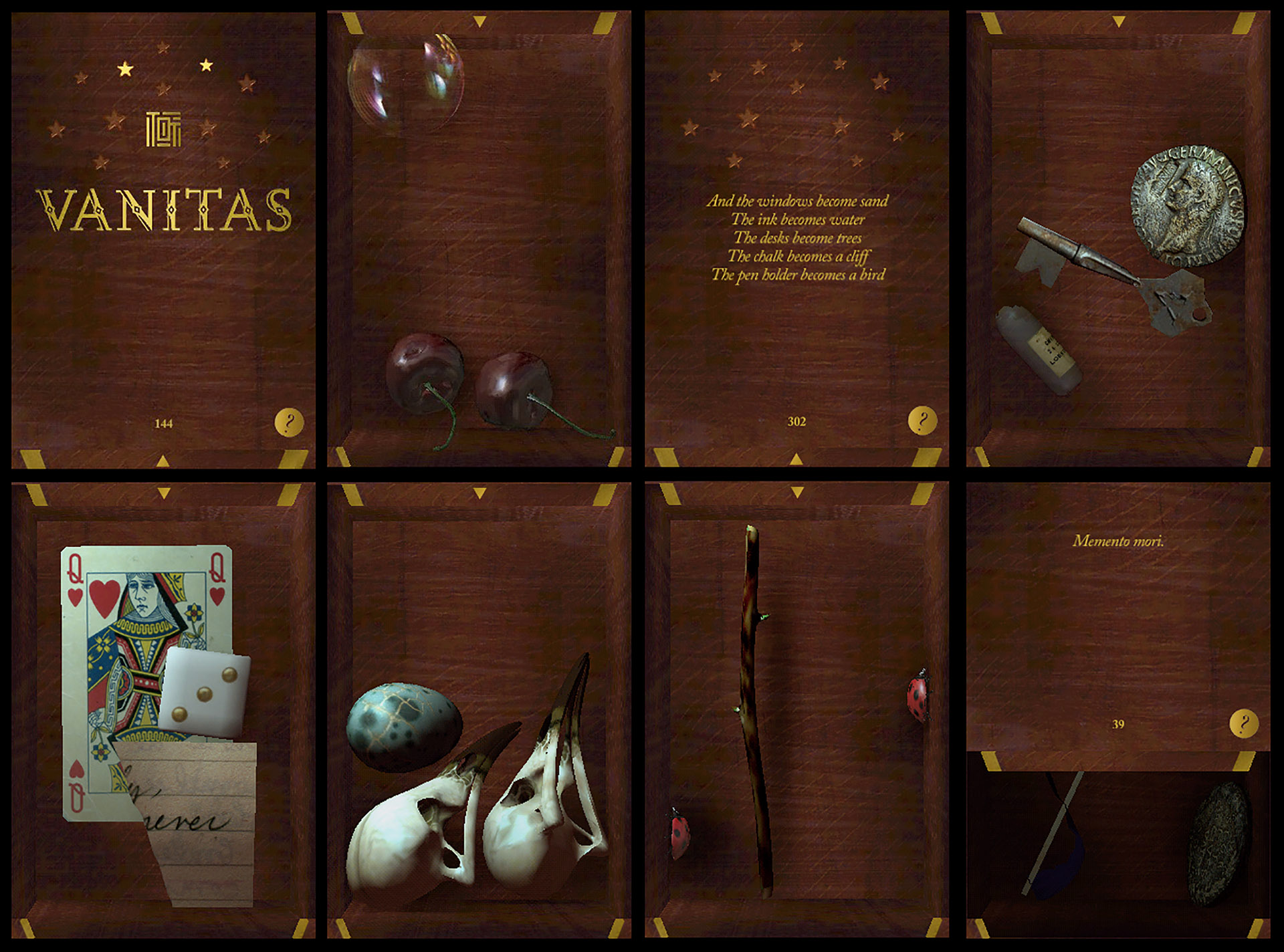
Auriea, your physical sculptural work is a key reference point for me in many ways. I know you studied sculpture, and I can see that in relation to your early web works and games. I was mesmerized by the materiality of Vanitas (2010), in which players slide a wooden box open and closed to discover changing objects in the box. When I turn the app around on a smartphone, the objects respond and move, and it is so captivating how the supposed density of the objects informs the speed and quality of movement, which made me think about how your relationship to sculpture as a medium has changed over time. What pulled you back to making tactile work in the last years, since 2015, when you stopped making commercial games?
AURIEA I think we’re all still dealing with the ways our lives changed during the pandemic. As it happens, I’m ending my professorship at the Kunsthochschule next year, in part because, for me, traveling back and forth from Rome to Kassel feels irresponsible towards the world and towards myself and towards my family, whereas before, I didn’t have that attitude. Another reason is that I’m leaning towards my personal practice more, which also developed during the pandemic. Odd but true: before 2021, I wasn’t considering myself a sculptor in all senses of the word. I considered myself an educator, and I considered myself an ex-video game designer, and someone who is trying to think about what the future or the way forward would be of the media that I loved, but when I had the chance to stay in one spot for long enough, I embraced sculpture. I started thinking more deeply about what sculpture meant to me. I knew that when I stopped making video games, I was no longer going to make these big sprawling projects that I’m trying to teach students to make now—projects that take years of time and multiple associations with freelancers and other people. I wanted a more personal, independent practice. 3D was my way into that. I had already been 3D-printing and linking that to the ideas of character creation and characterization, narrative, and interaction. But when I sat down in my small studio here in Rome, I started thinking about redefining sculpture in some way, just as I had felt free to redefine what a game was. That became the focus of my whole output—getting deeper and deeper into 3D, deeper and deeper into what is going on in terms of programing 3D online, and by extension, deeper into AI. These other forms came into sculpture and altered what I felt sculpture is and could be.
ELIO I’m curious to know how world-building and character-building have evolved for you during the 13 years of game designing with your partner, Michaël Samyn. How do these “worlding” elements work differently in the sculptural realm versus the game realm?
AURIEA In the beginning, when I was making net art, I was always trying to build a world, but it wasn’t possible yet in the sense of an immersive, three-dimensional space, so I needed to create a space inside the mind. The works that Michaël and I made initially were about us being in love. They were about a shared notion that digital media was a way of creating a physical connection with someone else, and thus they were very intimate and inward focused. When we started making video games, that was more outward focused—about the audience and their experience, their bodies behind the screen. We wanted to give people worlds they could inhabit and bodies they could feel like they were wriggling into. That required a ‘total work of art’ process. We were constantly making small operas. There were always musicians, and dancers, and writers, and other 3D artists, or artists in general, people drawing—all kinds of things. It was amazing to work in that way, but it was also all-encompassing.
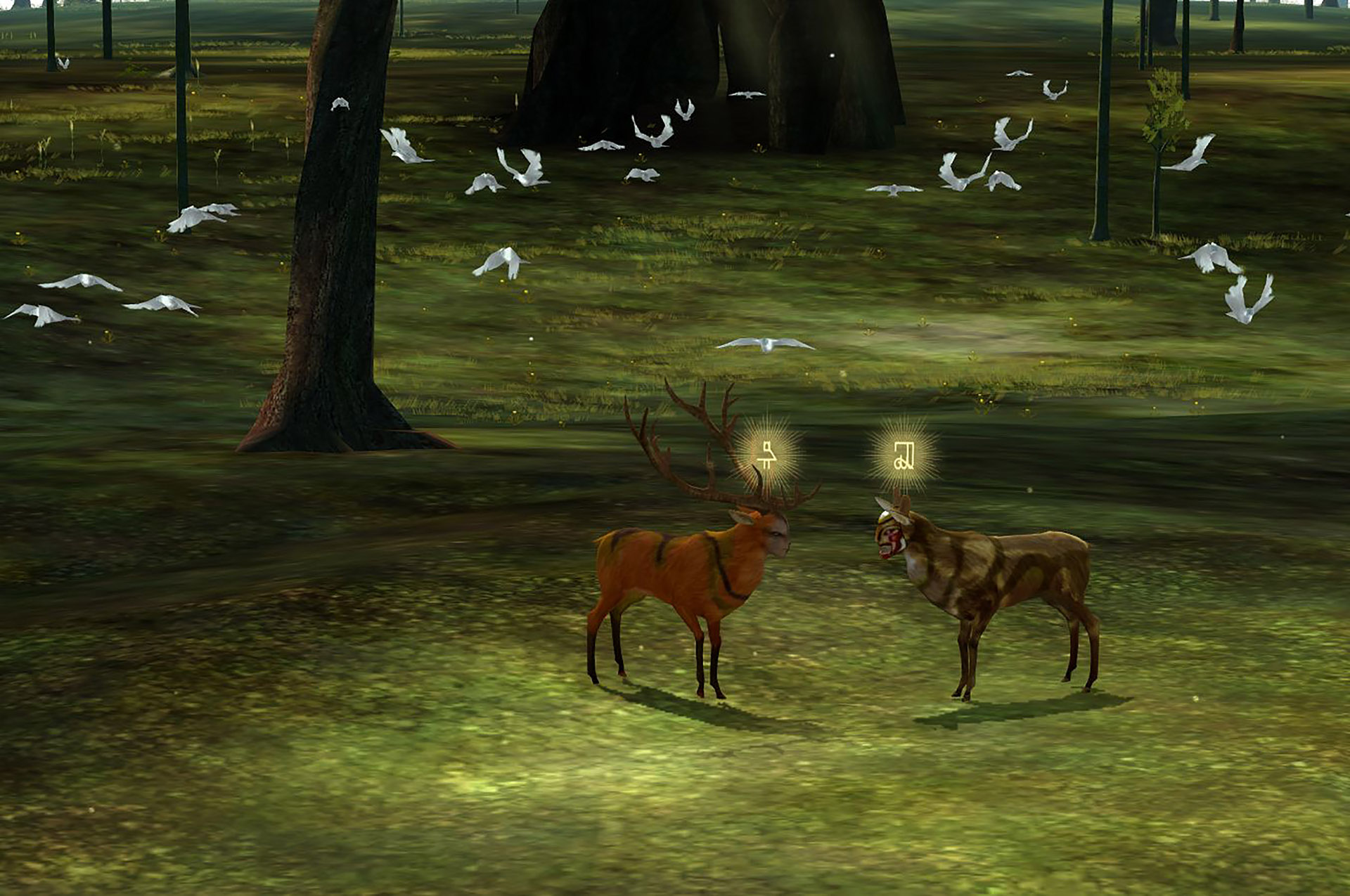
My approach to world building back then was “It doesn’t have to look real, it has to feel real.” With Vanitas, it was important to us to have objects that fit inside the screen. Everything real-sized felt like it could be in there, and then, indeed, there was the physics of making those things feel like they actually were something. There was a lot of illusionism involved. But take another game of ours, Endless Forest (2005), for example—nothing looks real in that game, but it has a timeless quality because of the kind of magic invoked by this deer with a human face and the fact that the foliage looks like it’s always in motion. The whole point is that you’re a deer and you’re running through the forest, so we tried to make that motion the most impactful aspect of the of the work. As you’re moving through the forest, somehow it feels like the trees are real.
When I started to create sculpture again, my thought was, “Okay, great, now it doesn’t have to move. It can just be something that stands there.” I was happy not to make a ‘total work of art’ in that sense—I could just make an object that sits in front of you. And, since I restarted this practice when none of us could actually be together, augmented reality [AR] played a large part. AR was a way for me to make sure that the work could be distributed and that people could feel it in relation to their bodies. There’s a solidity and a materiality to AR.
The thing I love about sculpture is that it doesn’t have to tell its story to tell its story. It becomes something that stands there, or, in the case of AR, gets projected into your world. It becomes this thing that tells its story along with you. You have to bring something of yourself to it, and you have to spend time with it.
Physical sculpture is interesting to me because not only does it become an archive of the data object—in terms of all the 3D modeling done in the computer suddenly being materialized into a form that stands as an archive of that data—it also stands within the context of time. The world changes around it. Software doesn’t really take on the new context of its time. It sits in whatever context it was created for, and it ages. Everything changes around it, but it doesn’t change, whereas I feel that a physical sculpture, once it’s in the world, the context changes around it, and the sculpture takes on that new context, as well. People will remember how a certain sculptural object was made or when it was made, but if somebody takes it to a new place and puts it in a new spot, it becomes something else depending on the light, depending on the location, depending on who owns it, who talks about it, who presents it. That does not happen with software in my experience. Software lives and dies just like everything else, but sculpture contains its own eternity somehow as a physical object. That’s why I love both. You need both when you’re dealing with data. I need both.
ELIO The idea of AR in relation to the body reminds me that during the pandemic, I looked at sculptures you showed as AR, and I still remember exactly where I looked at them. But when you speak about context, I think of time even more than place, and how a sense of time really seems pivotal in your work. I understand that your interest in making video games was partially influenced by a fascination with how long people would spend with games compared to looking at a painting or even watching a performance. You have also been invested in the idea of realtime and wrote the Realtime Art Manifesto (2006). The game dynamics in both Luxuria Superbia (2013) and Endless Forest have everything to do with time, as well, in that the quality of spending time and what actions are rewarded in the game is very different from, say, a shooter game, where you have a certain amount of time to win something. Your works provide a very different incentive.
Regarding the differences between data and physical sculpture, I’ve recently been confronted by the fact that the materials that are used for a sculptural work—bronze in comparison to 3D-printing, for example—bring so much of their own longevity or impermanence. Each material has its own timeline. They also prescribe how long it takes to work with them. This becomes very clear to me when I am glass-casting, compared to welding metal, for example. The medium requires a specific rhythm of making. You’ve said before that bringing the data for 3D virtual sculpture into the real world brings some kind of magic out, which I really like. I wonder whether you see sculptures as realtime art and how this magic that you describe relates to time in this experience.
AURIEA Let’s start with realtime art, because that still is very much a passion of mine. Within fine art circles now, this is known as simulation. I really love that word, too—simulation. It’s this notion that you’re always in the now. This is how it relates to time. Realtime art is “the time is always now.” There’s always one frame that’s going, that’s looping your information, your processing, your programing, and creating this world that seems to live or be half-alive. My connection to it today is the idea that, within the computer, you can create beings or situations that can feel like the passage of time that we have now, or like time is sped up, or like you’re being pulled through a different relation to time altogether. As an author, through simulation, suddenly time becomes a material that you can use.
When we wrote the Realtime Art Manifesto, we were just beginning to formulate some kind of artistic thought around time in virtual space. I think the reason why people spend so much time with simulations—or the reason they want to—is that it feels like a different kind of time. I mean, I used to play games where I would just be playing the same game for eight hours, and I wouldn’t even notice the time pass. That intrigued me as an art form, as a way of showing work where people have this different time relationship than to a painting or a sculpture, where, if you live with it, you forget it’s there, until every now and then, when you go, “Oh yeah, that’s on the wall,” or “Oh yeah, that’s sitting there.” These are, to me, just two different ways of looking at an object or an experience. They both have their advantages.
At first, I didn’t value that “it’s just sitting there” aspect of time, but now I do. Maybe that’s because I’m also getting older, and I have that kind of relationship to the things around me. Games are way more portable in that sense. You can take that time-based experience with you and access it anywhere. I make the digital versions of my sculptures because I also want them to exist in that kind of time. That was the idea behind Vanitas, for example. It was something you could pull out and look at or play with, without having goal-based demands on your time. We used to relate it more to the difference between a novel and a poem. You can read the poem in a short amount of time—maybe you only read it for three minutes—but then it stays with you for a lifetime, whereas you might read something else, like a news article, and never even think about it again. To us, that was what most video games were like—you had this experience, and you spent 20 hours on it, but it meant nothing to your life, long-term. We were trying to find ways to make games that could mean something to people long-term. Not necessarily the game itself, but the way you felt after you played the game or the conversation you might have with someone else about the game was important to us—the thing that sticks in your mind, not necessarily the game itself. So, there was a certain intent we had around the manifesto and around all the games we made.
When I discovered—air quotes “discovered”—3D printing through a friend, when I went to a fab lab and 3D printed something I had 3D scanned, and I held it in my hand—it was this little, pathetic piece of plastic—and I was like, “This is magic!” After years of making video games and characters and things inside the computer, actually bringing it out of the computer, I felt like, “This is the future.” But I didn’t know what to do with it yet, in part because of what you speak about—the materiality of the plastics that we print with. I went through a lot of different experiments and found that there are many ways in which filaments and 3D- printing supplies can be made from natural materials. It’s always a blend of things, and you never know quite what’s in it—that’s another problem—but you can get things that are made of wood, or metal, or different types of bioplastics derived from corn, or tomatoes, or oranges—all kinds of things. This affects the final surface finish, texture, and longevity of the object. I talked to conservationists many times—at the Cooper Hewitt Museum in New York City, for example, and at the Whitney Museum—asking them about the conservation of these objects and came to several different conclusions. In some ways, data will last longer. In some ways, an object lasts longer. Oftentimes, when I’m making a sculpture, I think about this—which will win? Will the data win, or will the object win?
When dealing with digital media, you’re constantly facing the ephemerality of that media. For me, now, with sculpture, it is extremely important to know that one can survive. I have no control over whether it does or not, but it’s important to me that one can survive, and I try to give both their best chance. On the data side, data is material. Underneath it all, a 3D model is just numbers. It’s sculpted math suspended in this eternity of a viewport in your 3D program. When you open it up in a text editor, you can see where all the vertexes lie. You could print it as a book. In fact, I should do that. “This is the sculpture, and here is the book of the sculpture.” Then, one day, someone could take all those numbers and reconstitute the sculpture. That’s another way of thinking about the material of that 3D object. Sometimes, the way 3D objects are made, or in some cases how I preserve them, is to take photos of them all around and reconstruct them via photogrammetry. Then that becomes the sculpture, as well. The idea that the object’s materiality can be represented in many different ways fascinates me.
As for the longevity of those materials, I enjoy using bronze, which is supposed to be forever—it’s the most eternal material if you don’t melt it down, and if it doesn’t get caught in a fire, though even then it’s not going to melt or burn as much as marble, wood, or other types of materials. People are always saying, “Oh, plastic, it’s forever also,” but it gets no respect with good reason. Plastic changes. Bronze changes in terms of its oxidation process. It will decay, but not in the same way that plastic changes. Plastic gases out. It gets sticky. It decomposes sometimes, depending on the type of plastic. So, I started thinking about other types of plastics. In the computer, objects can be made of anything—literally anything. I try to think of common combinations of virtual materials that couldn’t exist in the real world, and I try to make them in the real world, not copying that digital version, but making something that can exist according to these physical laws that we’ve got to deal with.
In Rome, you walk past all these antique stores and things of this nature with sometimes actual ancient art and sometimes just replica fake 19th-century bad copies of ancient art. I try to imagine something 3D printed in one of these stores, like some brightly colored, plastic, 3D-printed sculpture, and I can’t imagine it at all. It’s almost like you expect these things to be in museum gift shops, but not seen as antique. We haven’t gotten to the point where something like this can even be conceived of as an antique. The file that I use to 3D print from then becomes the thing that I expect to see in that antique shop—not the 3D print, but the model. I try to imagine many antique stores selling 3D models. That, to me, makes more sense.
What is your relationship to all of this, especially in terms of characterization and all the other topics that you’ve had in your work?
ELIO Combining the techniques like photogrammetry and 3D animation with glass and ceramics, I found surprising parallels in the processes and resulting aesthetics. For my graduation work at Sandberg, I showed kiln-casted glass sculptures, Host Proto I–VII (2023). You can see in them the kind of blurring and the clear-cut boundaries between the different glass pieces that I combined to make the objects, which reminds me of the glitches of polygons and imperfect 3D scans. For the kiln casting, I used pieces of recycled glass—leftovers discarded by other students. The glass pieces are put into the plaster mold, and then fused into each other. There’s this broadening of the boundary space in which the action takes place, which is prevalent in this process of melting glass together, that is very similar to purely digital or moving image or interactive game experiences that I’ve tried to create. For me that’s something very fascinating, this relationship of the technology of more traditional sculptural methods and certain image-processing tools.
I refer to Host Proto I–VII as topographies. They’re related to a game I made called Spit City (2022), which was last played at the Hackers & Designers Summer Camp. It’s a pen-and-paper game for collaborative worlding of more-than-human geographies and identities. During the playthrough, players draw a map together which records the various aspects of the collective storytelling. The experience of hosting play-throughs of Spit City informed the production of the sculptures. I wanted to explore the possibility of providing a physical point to world from, instead of beginning with an empty piece of paper and a ruleset. The idea is to host workshops with the sculptures as a starting point.
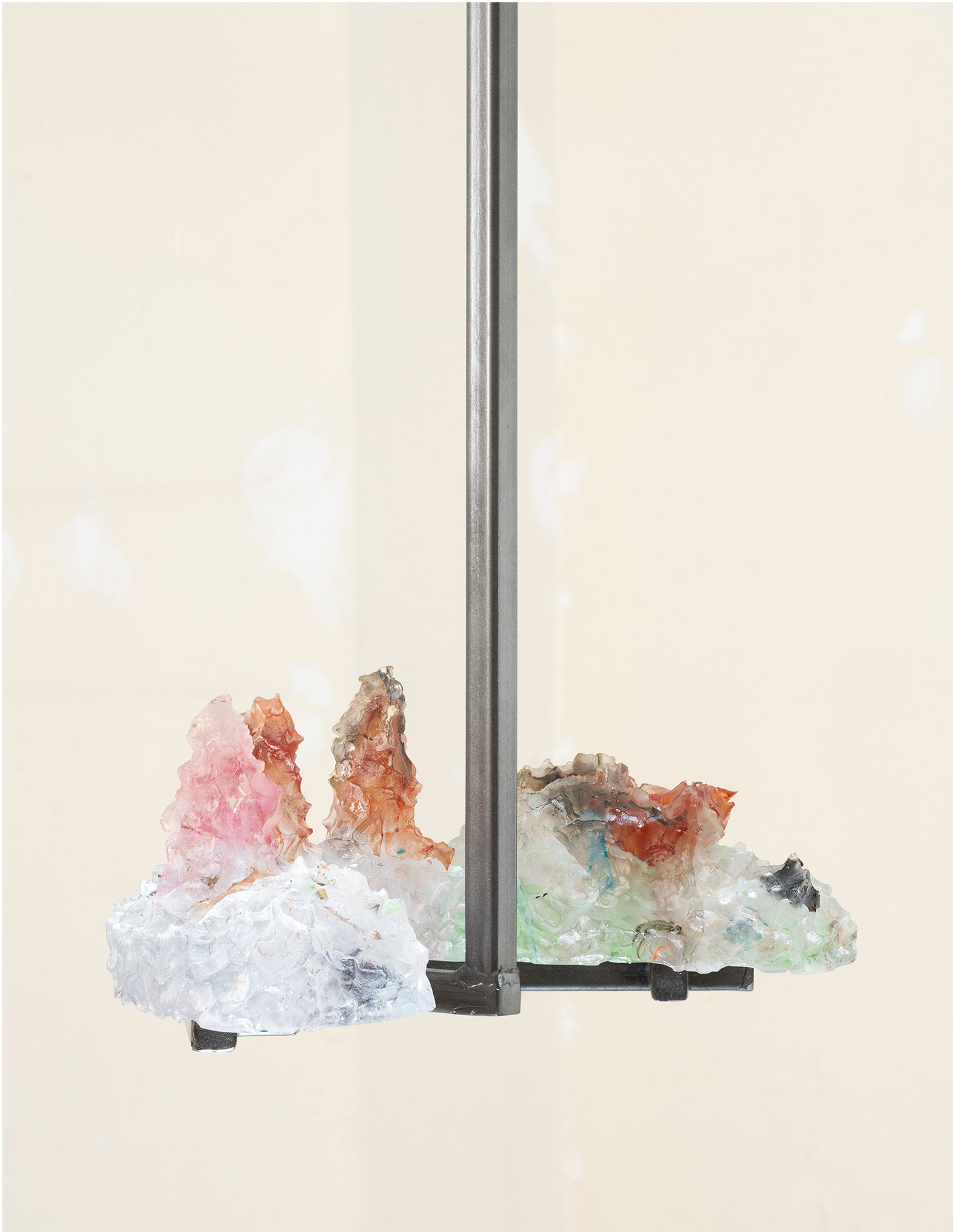
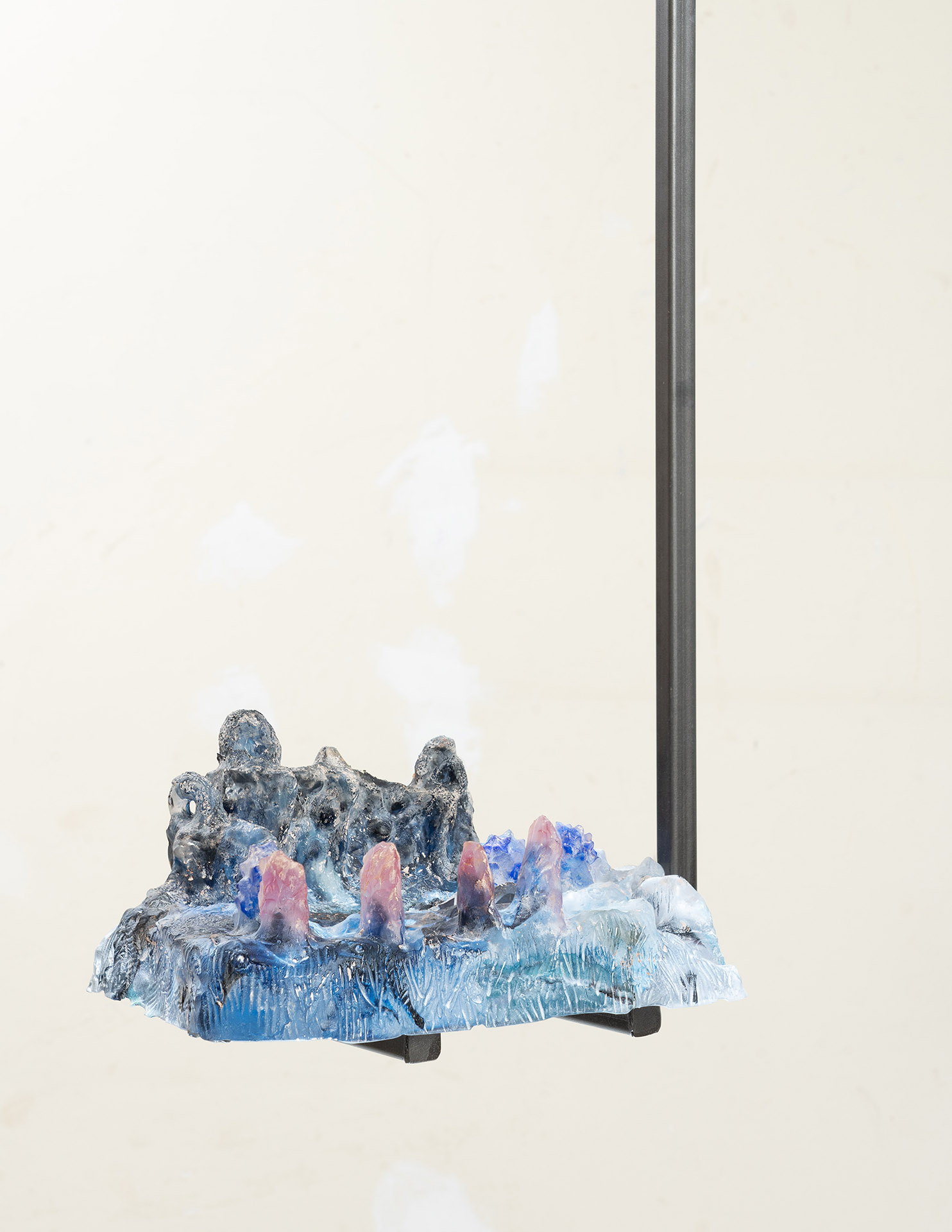
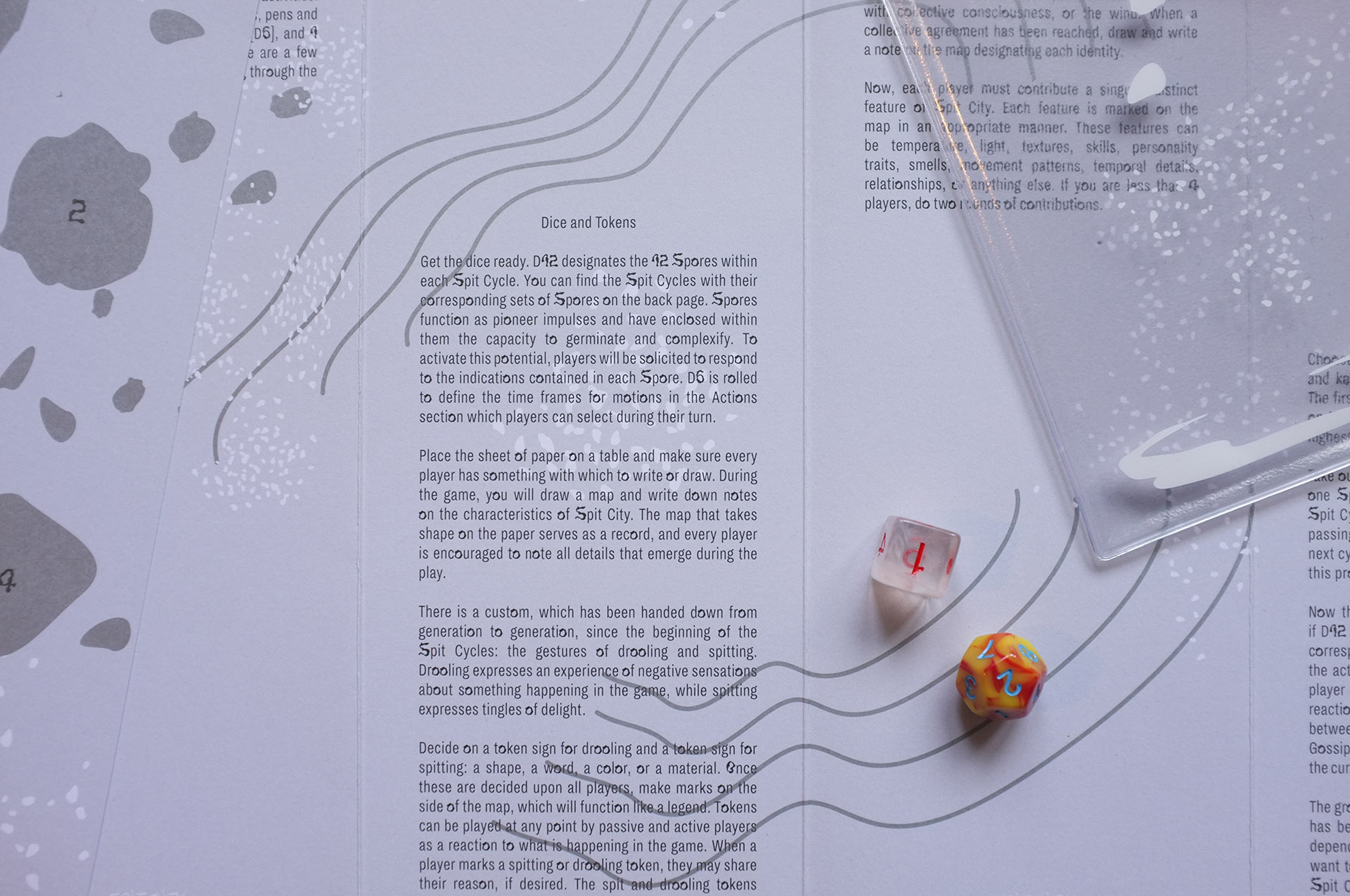
For me, the choice to use glass came from aiming for both the possible longevity and simultaneous fragility that marks the object in time. I wanted these topographies to feel precious and timeless. And like what you aim for when creating a virtual experiential space, I wanted them to have an intimate somatic impact. I have the sculptures in my studio right now, and when I’m quiet, sometimes I hear the glass moving. It makes a high-pitched pinging sound. The glass is never still. It’s sensitive to vibration. It moves. It could crack. This zinging of the glass is very realtime. It’s here and now.
AURIEA What is the source of the colors in the work?
ELIO The colors come from whatever recycled glass pieces are available. I can’t fully preplan that aspect. Another interesting detail is that different color pigments have different melting points. So, the conceptual logic of my process can result in different iterations of the same work, but I can never repeat the color, because, at least in the way I am currently working, it’s physically impossible. That means I can never exactly remake the piece. The positive and the mold are destroyed during the casting process. To recreate them, I would have to remold them, which is a translation process. I thought about the idea of iterations in relation to your work. Reading about your process, I came across a reference to August Rodin’s practice of marcottage, during which certain parts of a work are replicated and other parts get buried in the process. I understood that’s also the way that you think, for example, about the work mother/child (2020).
AURIEA Since I’m working digitally, I can make different variations of things, but there are different limitations once you enter the physical world. Do I 3D-print the wax, and then it’s a one-shot deal? Or do I make a mold, and an edition of one thing with the possibility of change? I refused to make molds until I started working with bronze. The first bronzes I made were straight shot from the 3D print. Essentially, the 3D print was the wax. I used the 3D print to burn out. That was a one-shot deal, even though I still have the 3D models. Actually, that’s how I prefer things to be when I’m creating a physical sculpture, but I work with someone for bronze casting, and he convinced me that molds are the way to go. Somehow, I’m really happy he did, because now, as with Gray Matter II (2023), there was a Gray Matter I (2022) and there’s about to be a Gray Matter III, and I don’t have to go through a bunch of stuff. He’s got the mold. He can just recast it. The changes come in the patina stage where I’m choosing different patinas and pairing that with a digital version of the piece, which is also different for each of these. There will be five of these in total, which is another topic: how do we stop creating versions? This artificial limit doesn’t make sense to my Internet brain. My pure, OG digital art brain is sitting here like, “You can have infinite copies. There’s no such thing as a limit. What are you talking about?” I make a limit sometimes to make myself stop and go on to something else.
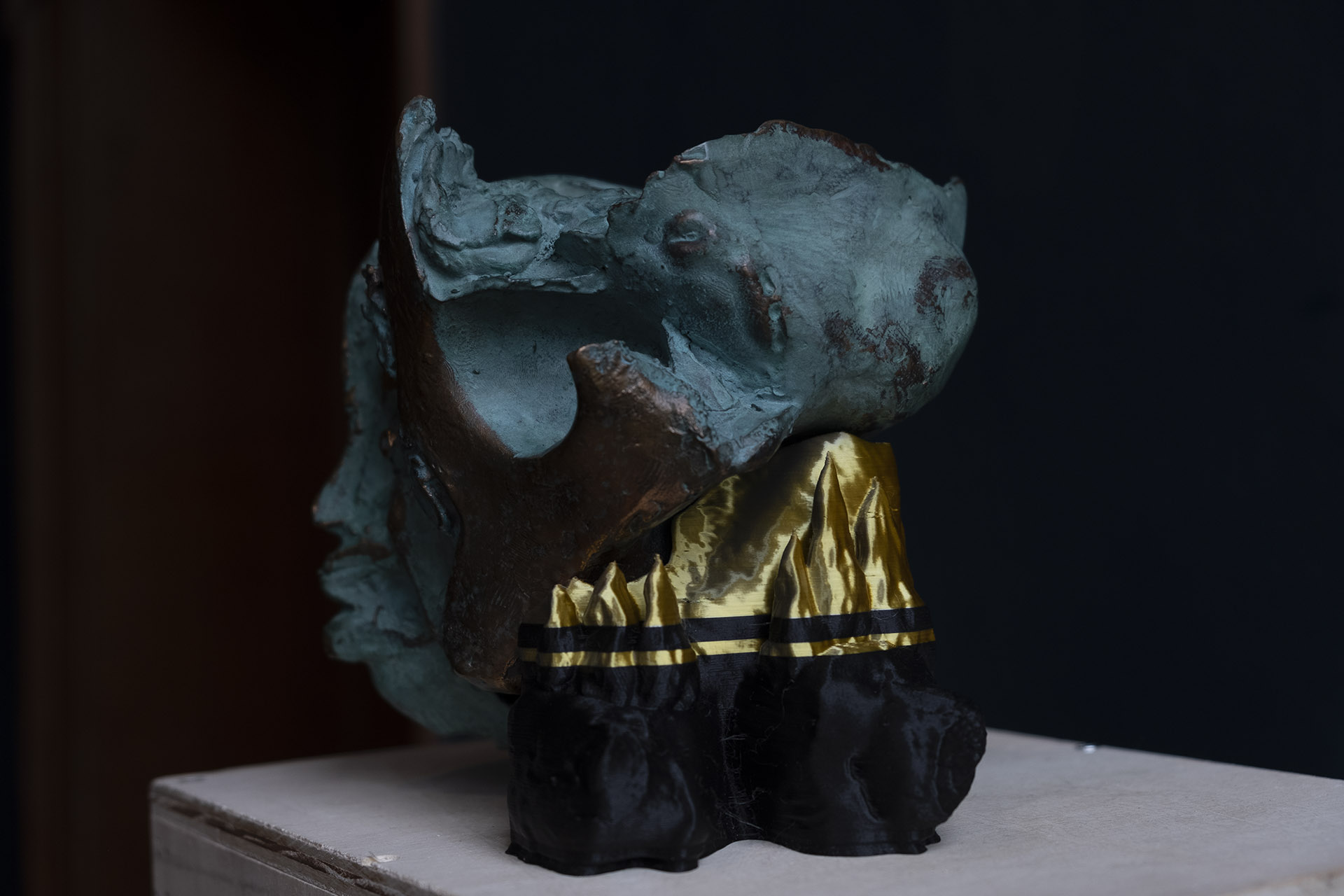
This process of Rodin’s you’re talking about is highly influential for me from the standpoint of his making bits and bobs—arms and legs and hands and models—then essentially collaging them together to create new forms. That’s something I saw all through my art history and all through my school time, and then afterwards, working digitally, it suddenly clicked that this is a beautiful way of working because you form your own vocabulary. I have my own library of forms that I work with, and I am always adding to it. It’s important to have that conversation with yourself as an artist. These objects are in conversation with your mind, with your intention. Also, if I’m honest, I don’t always like making a definite decision about things. I want to give myself some wiggle room to say, “Okay, I made that red, but maybe it should have been blue, or maybe I should have added another thing to that.”
Another factor is the storytelling aspect, where every change adds depth. The beauty, to me, of sculpture, is that the story has no end, or it has no beginning, or it has no middle. You can leave one of those out, and then go back and fill it in later. I think that’s what Rodin is doing, too. He was going, “Okay, it’s a man and a woman, and they’re kissing, but it’s a man and a woman, and they’re holding each other, and it’s really just the story of a man or a woman.” Whatever his sculptures are, he’s telling this ongoing story, and it’s the same man and the same woman every time, but they’re doing something else. It’s the same woman, and he’s taking her through all these different changes, giving it a different title, but in some ways it’s the same woman. At least, that’s how I see it when I go to the museum, and I’m looking at Rodin. Unless it’s a portrait of someone, I’m thinking, “What story is he telling here?” He’s deeply involved in a game with emotions, also a game with motion, everything looking like it’s about to fall over or run away, or it’s turning inward. That’s what I love about that period in sculpture in general, but his work specifically. Also, this idea of tak-ing you through different materiality—he worked in marble sometimes, but often his works were in clay. He was making the plaster. He had a huge studio. Somebody else was making that final bronze or that final marble. In essence, his job was to sketch all the time. His job was to sketch and to look deeply and find that subject and that way of getting through it.
My assistants are all machines, one computer or another, or 3D printers. Now, of course, I’m working with someone to make molds and cast bronze, but he’s constantly in dialog, asking me questions like, “How is this supposed to look?” It’s a funny process when you let go of certain aspects of it. I think this idea of creating iterations allows you to let go of parts of it at different times and to concentrate on other aspects of the story. I have to think about what it says if I make it a white sculpture versus a black one, or something like that, which is just a slider in a computer. When you’re dealing with real material, you’re talking about a completely different thing—say, the difference between your works in glass or if you were making them out of stone. When you say it could never be repeated, which I think is wonderful, because it depends on what you have, that’s like a diary in a way. Now you have access to these methods, but in the future, you might have access to something else, and then the work would change, too. Those types of changes that we go through that end up in the work make the work richer.
ELIO The possibility of allowing viewers to see different parts or iterations prompts me to ask about gaze or point of view. When I was making the experimental postporn Fragmented Delicacies (2020), one of the biggest challenges was to work with the parameters of the gaze in Blender, or at least what was automatically encouraged as a gaze—a kind of fixating drone gaze, viewing a scene from above. For the sculptures that I had made for this film to be experienced from the inside, scaled out of proportion as an enveloping, cave-like space, I used different image-production techniques to transport the ceramic work into the 3D environment, which became my virtual film set. I also had a physical film set, and, in the last steps of a lengthy editing process, the two were merged. I won’t go into all the steps, but I learned a lot and experimented with modifying the camera gaze within Blender. I ended up conceptualizing the gaze as multi-eyed, which for me entailed creating a set-up where the cameras are linked to the subjects and, as their movement starts, submit to the impulses of the participating subjects rather than being independently mobile, which was very counter-intuitive in the software.
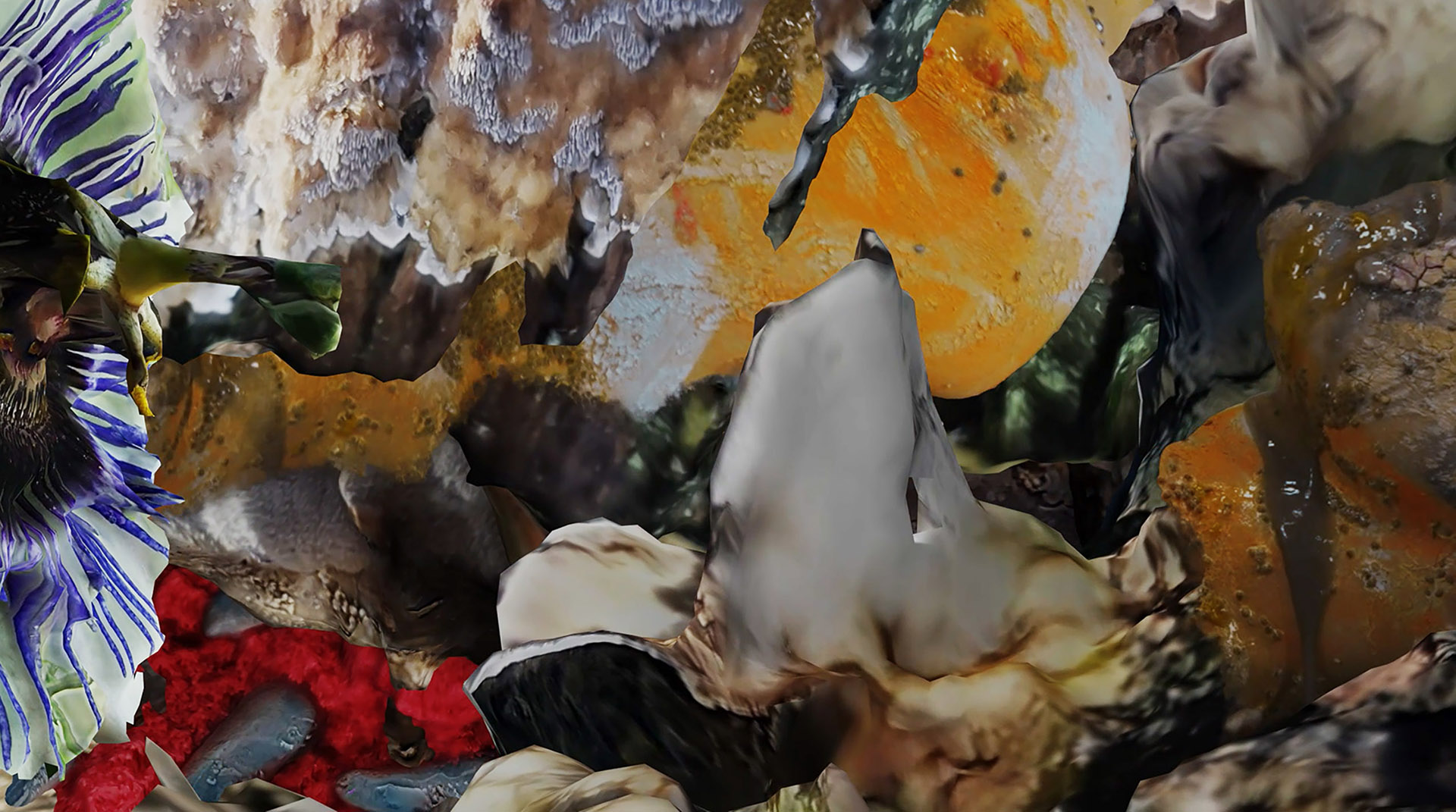
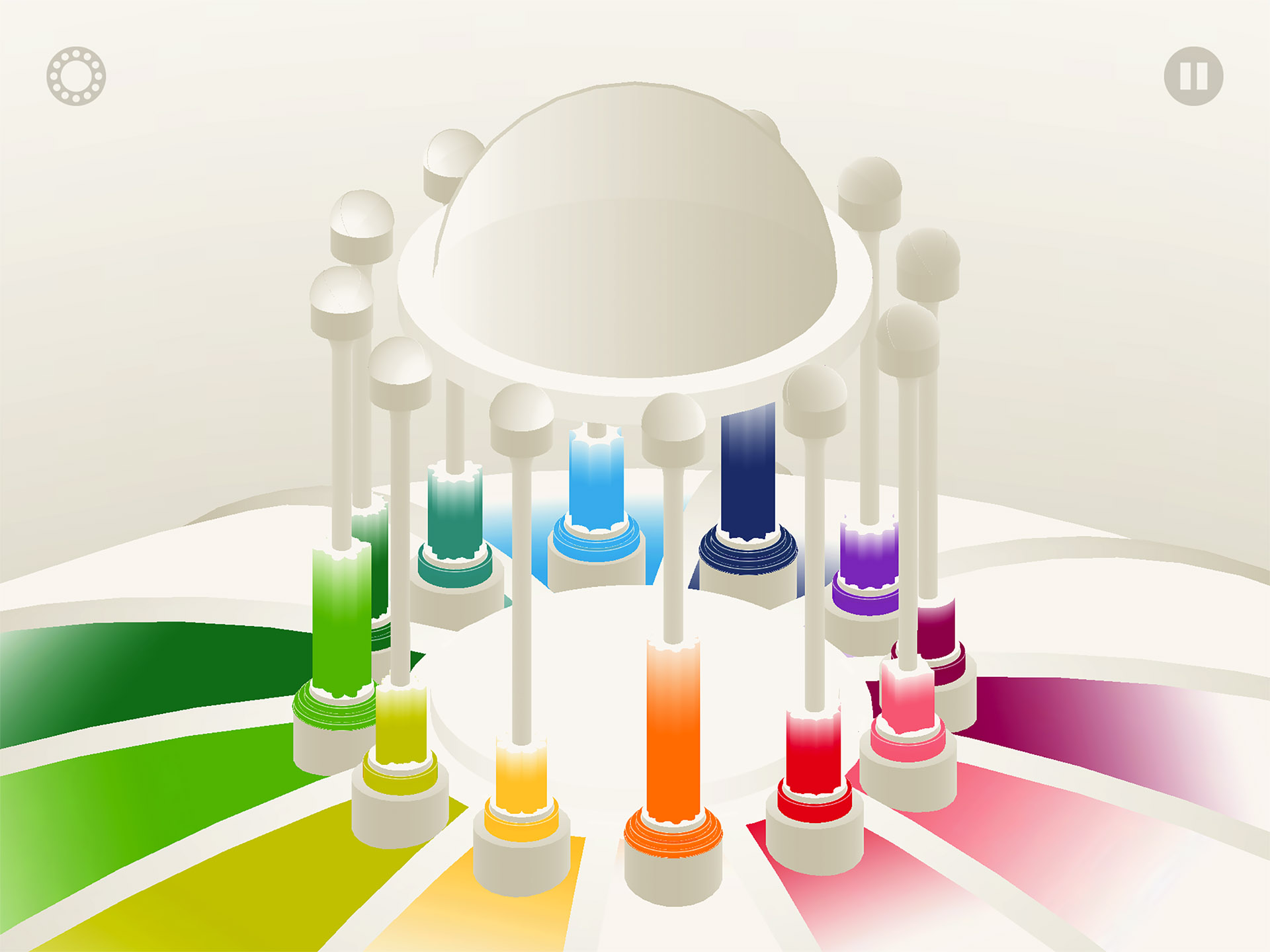
Your work, Luxuria Superbia, has a kind of tunnel perspective, where the player floats forward without a visible body of any kind. There’s a hologram star that one can control, and the tunnel is described as “a blank flower that becomes colored through touch, but not too much too fast, otherwise the flower or the round is finished.” So, taking time is rewarded through extra points. In my mind, Luxuria Superbia can be read as a postporn game. I want a postporn festival to take it into their online program. I think people would love it. You would have a whole new audience there!
AURIEA Luxuria Superbia as a postporn game—yes, that’s the intention. Thinking about the rhythm over time, each tunnel that you travel through has a different rhythm and elicits a different way to interact with the machine, with the tunnel, with the flower, or whatever we’re calling it. Some of my pieces are more interactive than others.
ELIO It’s really exciting to me how physically affective this game is without representing any physical body. In a way, I tried with Fragmented Delicacies to find ways to express other-than-human intimacy without focusing on fully rendered human bodies and anatomically realistic genitalia. Making physical sculptures has brought me back to reconsider one’s agency as an artist to guide or pace the gaze, for example, to refuse super-speedy short-attention-span consumption. This was the case with the glass sculptures. Visitors could walk past them with only a glance, but in order to unfold, they require time. I personally see a lot of potential for agency in how the work is offered to the audience, and I see that you do, as well. I wonder how you think about setting up the gaze with sculptures, how you approach the consideration of the viewer.
AURIEA Gray Matter is very much about entering into a sculptural situation and figuring out ways in which it’s alive and ways it’s not alive, on the one hand, but on the other hand, in order to enjoy it as a sculpture, you have to think, “Am I looking at an object? What is the situa-tion here? What’s the interaction here?” I’m always trying to develop the viewer’s curiosity about the situation in which they find themselves. They have to give it time, though, as you say, because you could just go, “I don’t get it,” and then close the browser. I’m hoping that they come to the situation with the willingness to invest a few moments to get engrossed.
I want people to see it from all directions, and I want them to have it with them everywhere. Deep down, that’s what I want—that you can take this thing on your phone, and you can look at the sculpture there, or you can have the real sculpture sitting on your table. To me, a gaze is an attitude. I want that curiosity. Of course, I’m setting them up for a certain way of looking at it, but I think with a physical sculpture, you have to bring yourself to it. So, it has whatever it is people bring to it. It’s a little confusing. I haven’t really thought about this aspect of a gaze, honestly.
ELIO For me, it was also new, which is why I’m still thinking about it. I decided to install Host Proto I–VII floating, because I wanted people to look at the sculptures from all angles. They were hanging at my chest height.
AURIEA When I’m installing a sculpture, I think meticulously about an exhibition situation. Usually, I like things to be higher, because people are standing, and I like it when things feel like they’re in the range from chest height to my head, roughly, because I know people are different heights.
The Whitney Museum did not want to execute the height that I wanted because they were thinking about accessibility. Someone might be in a wheelchair, or it might be a child. So, I put the monitor very low, exaggerating the floor, because it was already on a plinth, which was because they don’t want people getting too close. It’s always this negotiation between protecting the work and making it accessible. I put one widescreen monitor right on the floor. I had a sculpture coming from the ceiling, and a digital screen hanging from the ceiling, and then a physical sculpture next to it on a pedestal. I couldn’t place those high enough because of accessibility issues, so they were lower than I wanted them to be. You deal with it in that sense, but I’m pretty meticulous about these things.
I’ve had to learn the hard way that you can’t just leave it to chance. You can’t just say, “Oh, I’m going to put an iPad here and people are going to view AR on it,” because the people won’t look at your AR on it. It’ll be a mess. This led me to think more about touchscreens, in some cases, custom touchscreens like the large piece that I had at Upstream Gallery, which was a 68-centimeter-wide round touchscreen that I intend to work with for other pieces, now that I know it’s possible, because essentially you get ten touches—ten fingers—that you can use. In the usual case, I’m only using one, which feels like a waste, or possibly two if I’m going to pinch, but it feels like a waste. I’ve got ten fingers. That was in Luxuria Superbia. We were like, “You have to be able to use all ten fingers.” In fact, you could play with a friend.
Tactility becomes another thing to think about. The problematic was “How can anybody touch this without using their own device? I have to figure out how to make this an appealing situation, and, in fact, something that people will want to do.” That installation also required placing the non-touchscreen way up high where no one could touch it, because of course people were going to touch it since the other screens were touchable. But this notion of having physical, interactive art, I think is awesome. Important. It’s not like, “Oh, here’s a joystick.”
I saw the Worldbuilding exhibition in Düsseldorf recently [WORLDBUILDING: Gaming and Art in the Digital Age, curated by Hans Ulrich Obrist, Julia Stoschek Collection, 2023]. There, the solution was always “here’s a joystick,” with a few exceptions. There was one where you got an artificial belly that you laid across yourself for haptic feedback, which I also loved and would love to play with more. This issue of the installation, the exhibition, and interactivity, and wanting people to play your game there or in some way experience the work as more than just, “Oh, here’s this object, or here’s this painting,”—more and more that’s going to come to the foreground, especially since digital art is definitely considered more collectible now than it was even two years ago.
ELIO I’ve noticed that Christian references weave through many of your works. I’m thinking of The Graveyard (2008), for example. Or, in Endless Forest, where there are only other-than-human characters, mostly deer, but there is a bridge and an abandoned ruin with a stone crucifix that simulate traces of human life.
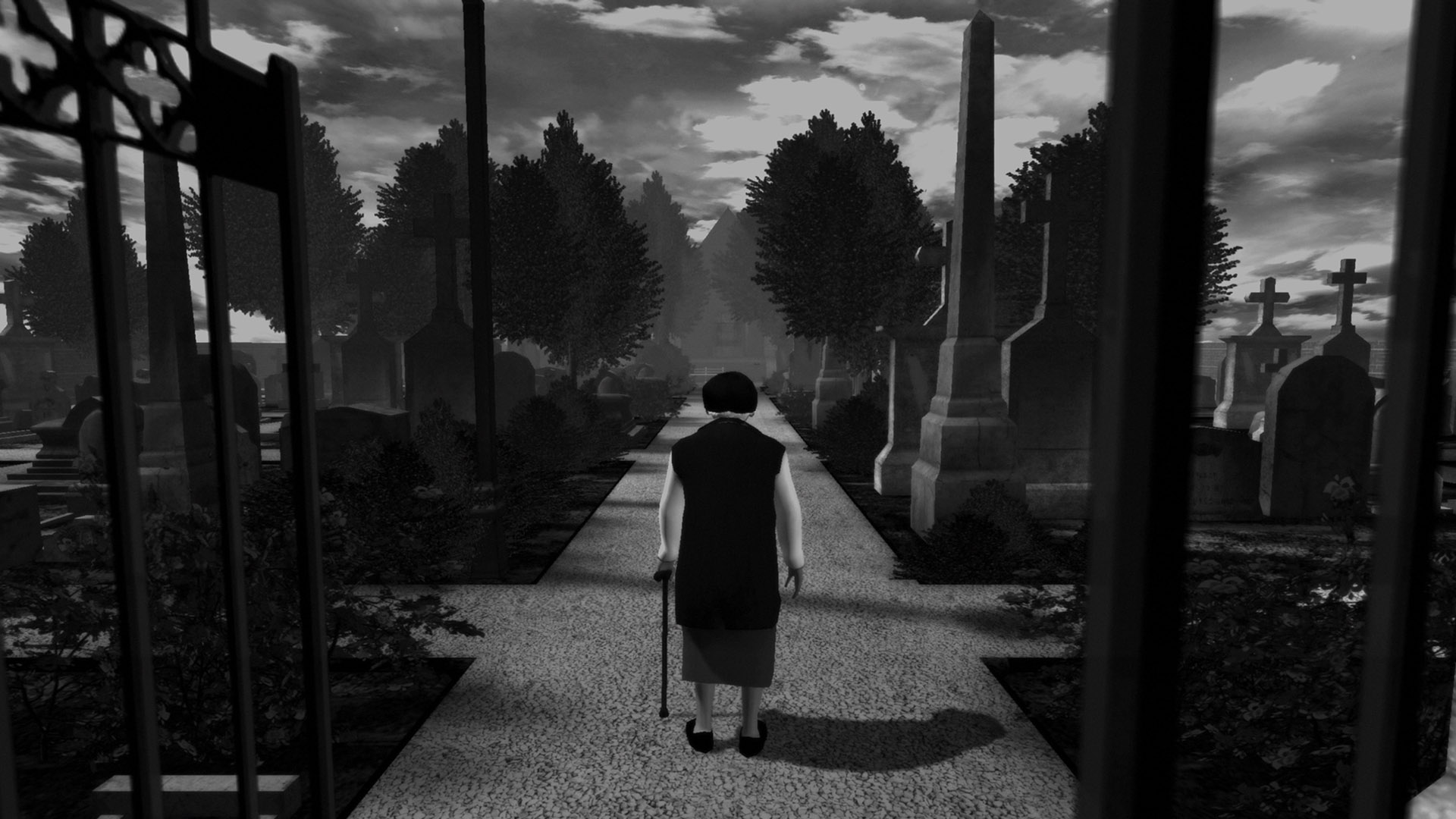
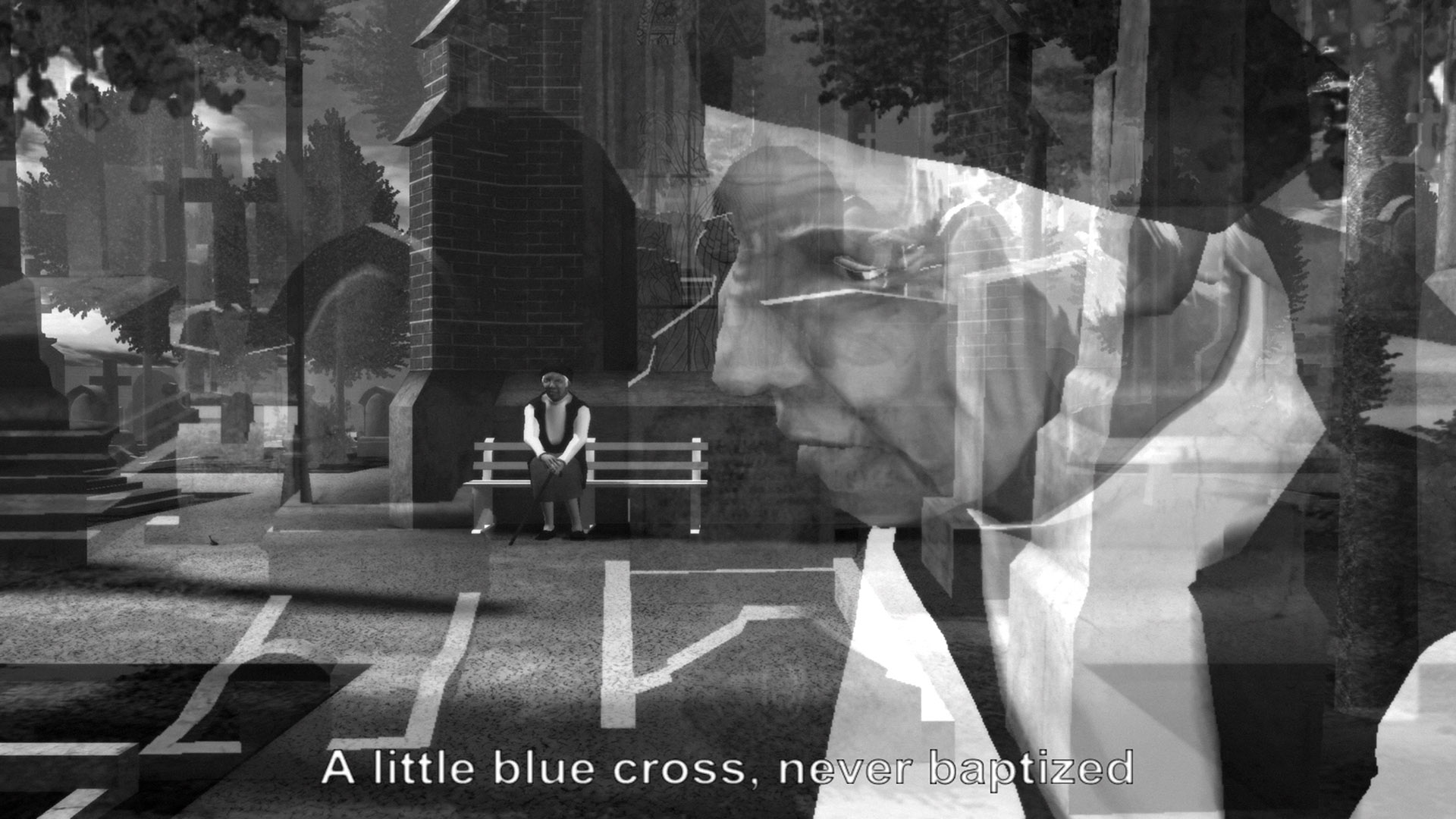
There’s the title of the work Alleluia! Alleluia! Alleluia! (2023), named for a word—quoting from the exhibition text—”used to bridge the connection between the physical and the divine body.” I’m curious to know what the function of bringing spiritual iconography and symbolism into the work is for you as individuals, but also as artists behind Tale of Tales [the game studio of Auriea Harvey and Michaël Samyn]. In the case of Endless Forest, I was asking myself whether the historical time of Christianity was intended as a marker within the virtual space.
AURIEA It has meant different things over different eras. When I arrived in Europe, I didn’t know anything about Christianity or Catholicism at all, because I grew up an atheist. It was fascinating to live in a medieval town, Ghent, in Belgium. It’s beautiful. I mean, if you’ve seen pictures of it, you’ll know it looks like a postcard of medieval architecture. The cathedral there became a very important place of learning for me in a sense. I was looking around at all these things, wondering, “What am I looking at? This is all amazing, but what is it?”
One finds incredible narratives in medieval paintings—of course, one of the most important paintings in art history is right there in Ghent at the cathedral, the Ghent Altarpiece [The Adoration of the Mystic Lamb, Jan van Eyck, 1432]. As an art history geek, for lack of a better word, it was important to me to be in the presence of such a beautiful work of art, and I was fascinated to learn more about its iconography. So, when Michaël and I were making video games, it became interesting to try to think of why things were the way they were in that virtual world of The Endless Forest. We were like, “Okay, the deer have faces.” There are many reasons for this, not having to do with anything we designed, but with the person who was drawing for us, Lina Kusaite, who kept drawing deer with faces. The deer also have this glowing symbol between their antlers, and this is the sign of Saint Hubert. He might have different names in different traditions of Christianity, but Saint Hubert saw a vision of the cross between the antlers of a deer in the forest. This became a symbol of conversion, in a way. We borrowed that. Once again—and this is not to say that we were doing things entirely superficially—it was from a feeling of tradition, of being in this place, surrounded by this iconography, wondering how we could understand these things better ourselves and help others to understand them as a part of this culture, also finding it beautiful, wanting to put that into the world that we were building as indicating something about where we were at the time, as well.
What you say about this being a marker of time was the intention of the cathedral ruins, but everything that appears in the game as one of the larger icons floating around the edges was part of a commission, honestly. That particular ruin appeared because we had a commission to show the work at the site of an abandoned abbey. We took the floorplan of the church that had been there on the site and put that into the game. It was a co-location of one place in the real world into our virtual world. It’s like that with many of the things that you see in the world we made. The place that we call the drinking place or de drinkplaats in Dutch is basically a little pool of water that’s constantly running. If you walk into this circle, you are transformed from a deer into another animal—a bird or a rabbit or a frog or something like a raven. This is also from a painting called De Drinkplaats by the Flemish artist Roelandt Savery—we were commissioned by a museum in Belgium to install the work inside the museum, and we put it next to this painting. So again, co-location.
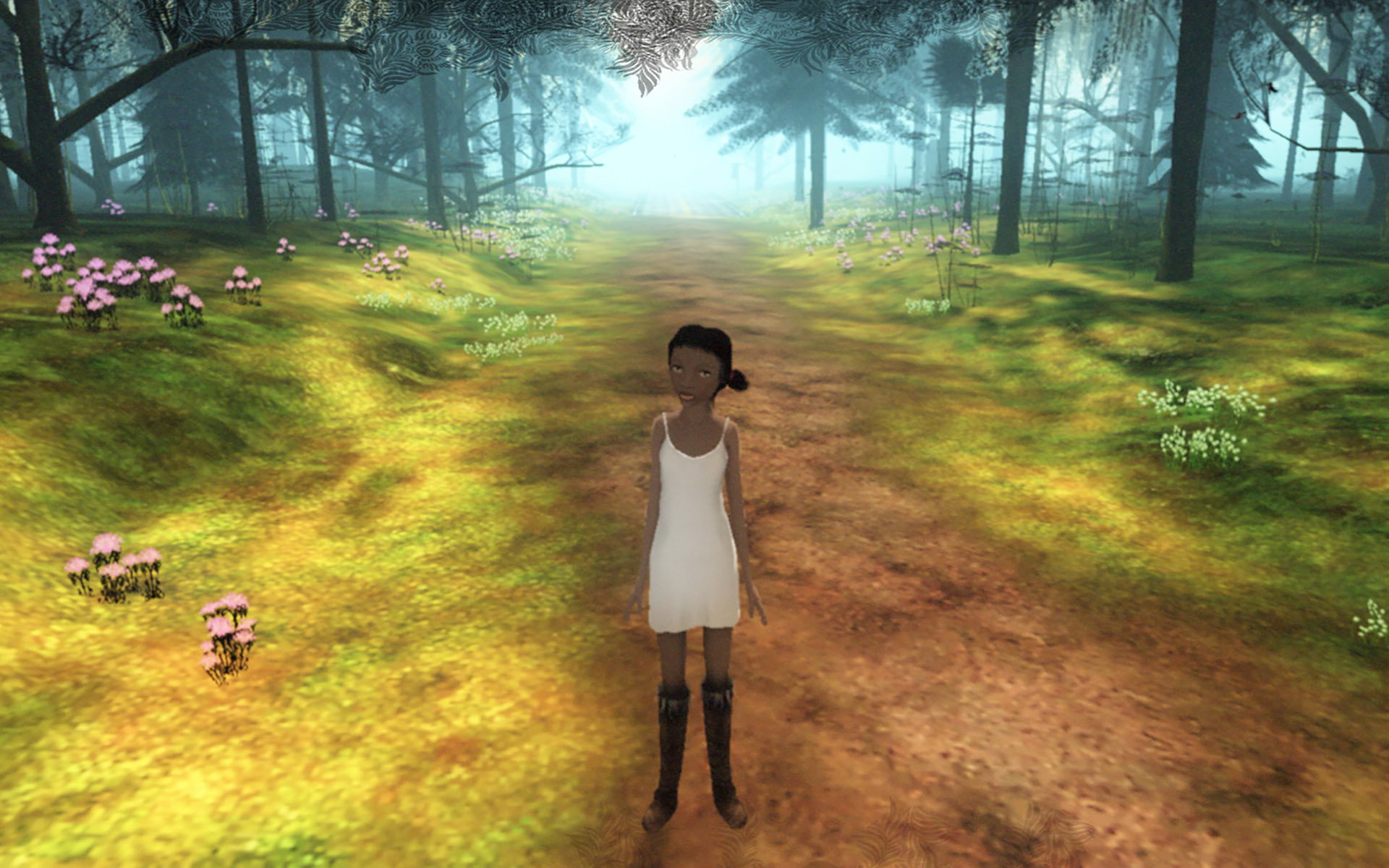
Every game we made with Tale of Tales had some sort of underpinning that connected the game to a larger cultural icon, like the story of Little Red Riding Hood in The Path (2009), or sex in Luxuria Superbia, or this idea of the vanitas in the game Vanitas, being these paintings that are supposed to remind you of beauty and death. That’s a strong element of all my sculptural work—this idea of vanitas—thinking about the mirror and the idea that you’re looking at yourself through a mirror that is warped.
After Michaël and I stopped making video games, we decided to embark on a project where we took these Christian themes more seriously. We created Cathedral in the Clouds (2016–22), which was a serious inquiry and research project looking into the construction of the cathedral building as a sacred space and of how spiritual meaning is derived through spatial logistics and materiality—material culture as it relates to divine influence.
When we were working on Cathedral in the Clouds, we were just dealing with what we knew, which was Christianity, even though we were seeing it from the outside as atheists, doing a sort of ethnographic study of Christian iconography, which again was somewhat superficial, though we came at it with honest hearts, you might say. We got a residency through the Belgian Academy in Rome, and we came here and stayed for five months. I was researching relics as virtual objects, talking about them as they exist in physical space, while their main function is virtual in that they are replicated. There are so many pieces of the true cross, so many holy stairs in different parts of Europe, so many piles of various saints’ parts. The factual quality of them doesn’t really matter, because their power comes not from the fact but from the divine. They are the object as a key, which led me back to sculpture, because, to me, sculpture has that quality.
In the Bible, it says you shouldn’t create idols, but what is an idol? An idol is an empty shell into which you call down the spirit of a god, and then you worship it. If you’re not doing that, you’re not making idols, it’s just an object. In Christianity, in Catholicism, they say, “We don’t worship these objects anyway. That’s not what this is. Obviously, we are venerating the object as a key to understanding.”
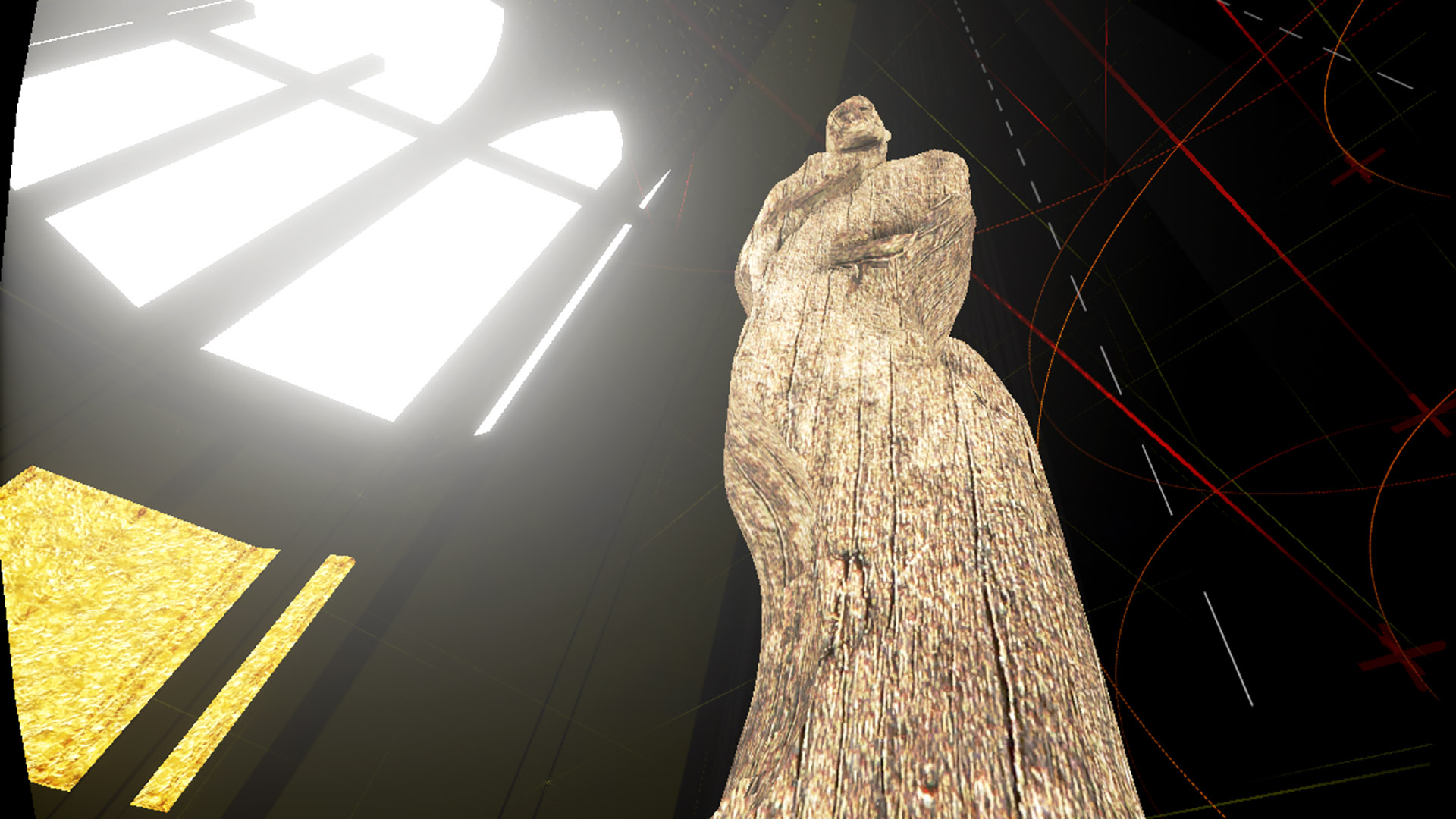
I recently converted to Catholicism, because I found a deep interest in Christian meditation and prayer, which led me to the idea of what it means to forgive. How can one find forgiveness for others and for oneself in a world that’s crazy like ours? How does one become happy or satisfied in this world? This is not really art related, but at the same time it is art related in that I’m always thinking about the objects of material culture, the things that we produce, and their effects on us as human beings, spiritually or otherwise. Certain objects are meant for the spirit. Certain objects are meant to connect you to the divine. And isn’t that fascinating? Like, why do we humans do that? We do that worldwide. Why do we do that? That’s also what a sculpture can be.
So, my answer to the question is that it’s meant different things to me over time, and currently it is an investigation into how objects link us to the divine—to what we’re really looking for in life, which oftentimes is a connection to something beyond ourselves, something that gets us out of our own heads and out of our own bodies, while at the same time not denying that we have our bodies. I’m dealing with virtual shit all the time, constantly. My practice is primarily not even there, in a sense, yet I see that people connect to these virtual objects, talking to things that don’t exist, like AI. This is very important stuff that we’re dealing with, virtually, now. Is it meaningful? Or is it just late-stage capitalism doing its thing? We’re in an interesting moment, and I don’t have any answers.
ANGIE Reflecting back to the beginning of the conversation, which focused on the relation between data and physical objects, I’m curious to hear from both of you about how your own subjectivity—that is, the way you experience being a subject—has been impacted by the idea that information is ‘a,’ or even ‘the,’ fundament of life. There’s a group of research physicists and chemists that conceives of biological life in terms of informational complexity and is working to define life as something like the universe’s way of preserving information over time. Accordingly, we are a biological life form enabled by information sustained over eons in the form of our DNA, and we, in turn, externalize information into living and nonliving objects that may outlast any single one of us—like sculptures and bits. At least, this is one way of thinking about reality. Auriea, since sculpture, as you conceive of it, seems like a literalization of this idea that data and object are one, and, Elio, since you’re dealing with the possibility of a multitudinous gaze, I’m wondering how you two relate to this concept of information as the basis not only of objects but of being, which also seems to underlie debates about AI sentience.
AURIEA I don’t know how to answer that, but this is something I think about. How does it all fit together? I’m always trying to connect people to ideas. I mean, what is art, right? Connecting people to ideas through time using media, using data. Information as the basis of being? Yeah, absolutely. One of my favorite places to be is a museum with a historical, encyclopedic collection. Not only am I interested in how those objects got there—like, why am I in Berlin looking at the Ishtar Gate?—but also, what am I looking at? That’s the thing I’m asking myself over and over again at a museum. What is this? Who made it? Why did they make it? Why is it here? Where did they find it? All the questions. We’ve turned objects into data in that sense—things that are cataloged and explainable—but for the people who handled that object, sometimes it’s a utilitarian object that makes sense, like a lamp, but sometimes it’s a doll or it’s something that we don’t even understand. Those are the objects that I’m really interested in, where there’s some connection to them that we can’t relate to anymore. Or, archaeologists and art historians make their best guesses about what the object is. “Oh, they made fake food in terracotta as offerings.” Did they? Through this lack of knowability, I find an opportunity in some ways to bring us as modern humans into this dialog with the ancients, with the divine, or whatever.
With Catholicism as a potentially dying religion, part of what fascinates me is the way that they want you to look at the world in a particular way. You don’t really sign up for that. When you take on the Catholic faith, you pledge certain things, but a particular worldview is not one of them, because it’s not like the world stops. It’s not like you don’t have free will. That’s something you do sign on for—to have free will, and to be responsible for that free will. What I’m trying to say is that it’s important to me that people feel connected to something beyond themselves and that that something is beautiful, good, and true.
Ultimately, I am just a simple sculptor who wants to create work that plays with this mystery that’s already in the world and brings it to people in a way that gives them some agency within it to find their own interpretation of it. In all our games, it was the same—we didn’t want to tell people what to do. We’re not trying to tell people to go here and do this and get points. And I guess I felt that with Catholicism, as well. Even though there is a lot of, “Do this, don’t do that,” at the same time, there’s also this yearning that one has within oneself to be curious about why this thing is within us that wants to create these objects that mean more than they seem.
ANGIE What you just said about not having a point incentive in your games, and relating that to religion, I think also relates to art. Some of the recent advances in AI have involved universal gameplay. An AI was created that could learn to play any game and maximize points in any kind of gaming framework, and this was considered a huge breakthrough success. But I imagine that your game as an artwork might be confounding to an AI, because the scoring structure is only metaphorical. Winning has to do with spurring and gratifying curiosity, rather than competing. Simply playing is winning. Can that kind of enjoyment be codified for an AI? I also see a connection with what you’re saying about religion and religious practice as relates to the profundity of objects paralleled in this ‘spurring and gratifying’ conception of art, which brings up an implicit confrontation with the premise of AI-generated art.
ELIO I don’t know if this is a direct answer to your question, Angie, but I feel drawn to talk about imagination in relation to curiosity and information, because my work wants to facilitate imagination. Computable information as a rationalizing force can be very restrictive of imagination. I do not believe that the experience of being can be entirely broken down into data. What comes to mind is also that it makes a difference if information recorded is ultimately used to widen or narrow down a perspective on something. During playthrough of Spit City, I usually feel resistance from adults to engage in stepping toward something magical—beyond what they believe is rational. For me, it’s important to create spaces that allow people to reorganize the information they think they know. The ruleset of Spit City, for example, requires players to temporarily agree on stepping out of what is assumed as possible reality—allowing themselves to believe something, even if it is in a limited capacity—it can be meaningful to step into that.
Internally, this has been revolutionary for me. In my experience, experiential play, and what you’ve called “noncompetitive” play, is too often designated as childish or senseless if it’s not put into a framework of “play means winning.” Which information is worthy of being taken seriously is pre-coded. I’m interested in thinking about the role of play in a work that is not explicitly a game. That thought is always in the background for me, even when I’m not making a game, even if the sculpture is not used in a workshop where visitors can actually play with it. The idea of play and how I use it in my work is linked to imagination, which has the capacity to expand thinking beyond the categorizable. Regarding subjectivity, I also think of role play, which could be understood as multiplying one’s own perspective. Spit City encourages the player to imagine themself as a subject who is more-than-human. It’s almost an experiment in body swapping—jumping into an experience imagined outside oneself. The process of this game leads to becoming self-conscious in the sense of, “Oh, what would I do if I could be anything?,” but also “What information am I bringing into this?”
Auriea, I really appreciate what you shared about your faith. I was raised Catholic, but now identify as atheist.
AURIEA Thank you, Elio. All the ways you’re exploring consciousness and embodiment are exciting to me, and I’m curious where you’re going to go next.
I like this idea that a game can be confounding to an AI. A lot of studies have been done about what makes a game addictive—games like Candy Crush. An AI would readily understand a game like that. The Endless Forest, which we intended for people to just dip into and play for five minutes, has people who’ve been playing it since they were very young, who still go there to visit this virtual world and be a deer for a while. Perhaps that would be confounding to an AI.
It’s also important to remember that games are part of a larger culture. If people have difficulty or resist playing them, don’t feel discouraged from making games but be aware of the changing attitudes that people have towards the medium. You as an author are very much in co-authorship with the spectator in a way that doesn’t happen in theater. You’re asking them to embody something that they struggle to imagine, and you’re helping them through the game to imagine that thing that could be something more-than-human or nonhuman.
ELIO Yeah, there’s an invitation to wonder, which is also necessary, I believe, to perceive something divine. It won’t come if you don’t want it to.
AURIEA The game always requires stepping into the circle.
ELIO Exactly. In that sense, the invitation, the way of inviting, is so important.
AURIEA And there are many ways to invite.
ELIO Absolutely.
ANGIE Thank you so much.